Greenhouse Cooling Systems Engineered for UAE Conditions
Design and supply of pad-and-fan, high-pressure fogging, ventilation, shading and hybrid greenhouse cooling systems for hot-climate projects across the United Arab Emirates.
Cooling a Greenhouse in the UAE Is a Design Problem, Not a Product Choice
The same greenhouse, in two different Emirates, may need two different cooling strategies. A system that performs in Al Ain can underperform on the Dubai coastline. Before any equipment is selected, the site itself must be analysed.
Hot-Humid Coastal Zones — Dubai, Abu Dhabi, Sharjah
High summer humidity raises the outdoor wet-bulb temperature, which limits how much evaporative systems (pads or fog) can cool the air during peak humid hours. Coastal projects often require hybrid strategies that shift between evaporative, ventilation and, in high-specification projects, mechanical cooling.
Hotter, Generally Drier Inland Zones — Al Ain and Interior Sites
Inland sites typically reach higher dry-bulb temperatures but with a larger wet-bulb depression. Evaporative cooling has more room to work — provided airflow, pad sizing and water quality are engineered correctly for dust and mineral load.
Solar Load
Peak solar radiation drives most of the heat entering the greenhouse. Shading strategy and covering material directly change the cooling capacity the system must deliver.
Water Quality & Dust
Brackish or desalinated water affects pad life, nozzle wear and bleed-off rates. Airborne dust loads filters, pads and nozzles — filtration and maintenance access must be designed in from day one.
Geometry & Crop
Greenhouse length, span, height and covering define the airflow path; crop species and growth stage define the target temperature and humidity band the system must hold.
Because achievable cooling depends on the wet-bulb conditions at your specific site, Green Climate does not quote a fixed temperature reduction before analysing your project data.
Greenhouse Cooling Solutions Compared for UAE Projects
Each technology has a defined operating window. The table summarises how Green Climate positions each option when engineering greenhouse climate control for UAE conditions.
| System | Best suited conditions | Main advantage | Primary limitation | Water requirement | Energy requirement | Required project inputs |
|---|---|---|---|---|---|---|
| Pad & fan cooling | Drier inland sites; greenhouses with a suitable airflow length | Proven, cost-effective evaporative cooling with high air exchange | Temperature gradient along the airflow path; performance drops as humidity rises | High (recirculated, with bleed-off) | Moderate (exhaust fans) | Dimensions, orientation, water analysis, electrical supply |
| High-pressure fogging | Sites needing uniform cooling and humidity control; wide or long structures | Homogeneous effect across the greenhouse; doubles as humidification | Needs treated water; effect narrows during peak coastal humidity | Moderate (treated / RO water) | Low–moderate (high-pressure pump) | Water analysis, climate data, ventilation design, zoning plan |
| Hybrid cooling | Coastal and variable climates; year-round production targets | Control logic selects the right mode for each hour of the day | Larger engineering and automation scope | Depends on mode mix | Optimised across modes | Full climate dataset, crop plan, water and power data |
| Mechanical / chiller cooling | Semi-closed or closed greenhouses; high-value crops; humid peaks | Temperature control independent of outdoor humidity | Highest capital and energy intensity | Low–moderate (system dependent) | High (kW per m² must be engineered) | Thermal load calculation, electrical capacity, envelope specification |
| Shading & ventilation | Every project as the baseline layer; shoulder seasons | Reduces solar load before it becomes a cooling load | Not sufficient alone in UAE summer peaks | None | Low (vent motors, screen drives) | Structure type, covering, automation readiness |
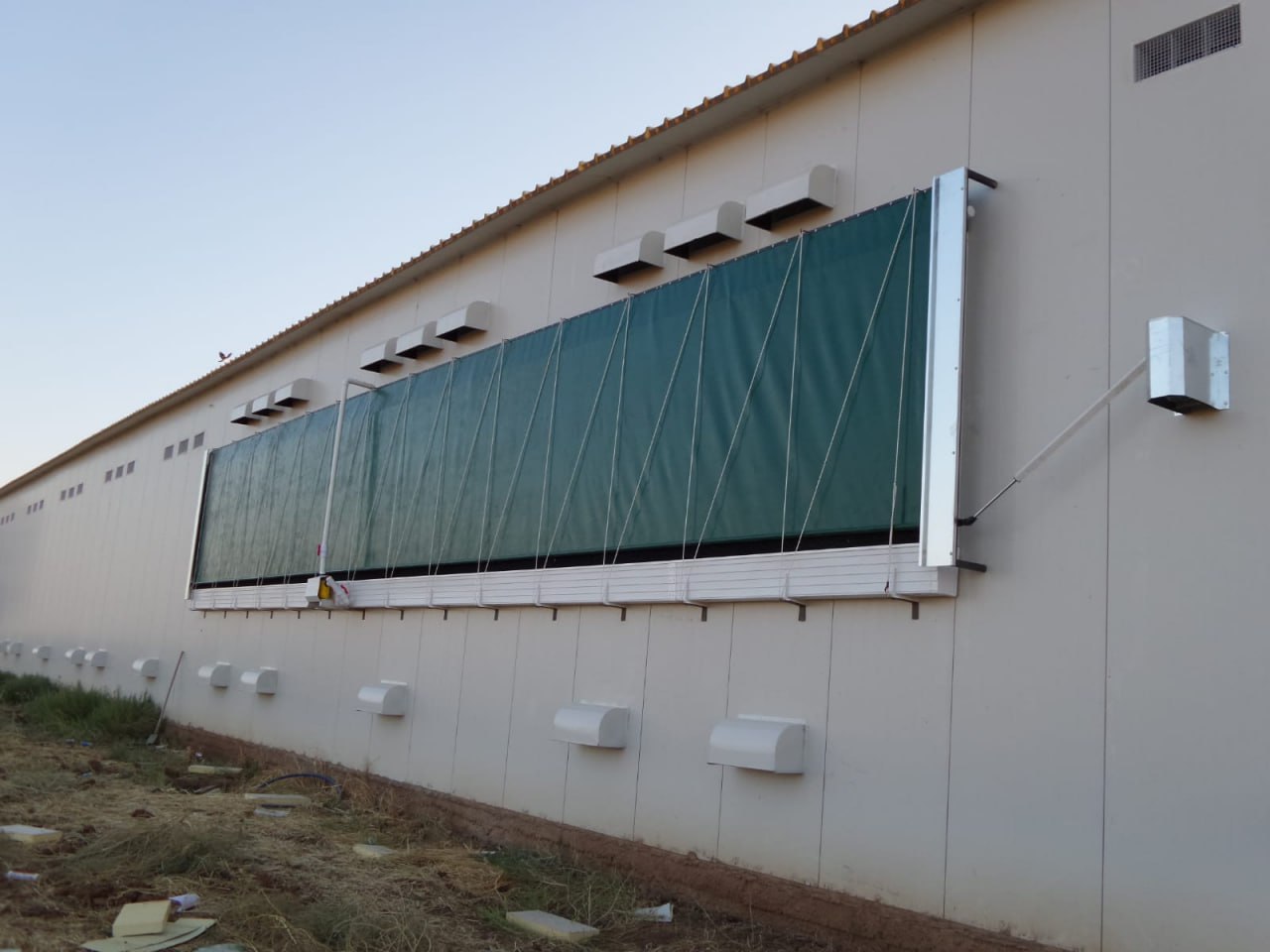
Cooling pad wall installation — Green Climate supply
Pad-and-Fan Cooling Systems
Air is drawn through wet cellulose cooling pads by exhaust fans on the opposite facade. As water evaporates, air enters the greenhouse cooler and more humid, then absorbs heat as it travels toward the fans.
- Cooling pads: pad area and thickness are sized from the design airflow and site wet-bulb data — not from catalogue defaults.
- Exhaust fans: selected by airflow (m³/h) against real static pressure, including pad, screen and crop resistance.
- Temperature gradient: air warms along the greenhouse length; the pad-to-fan distance must match the crop's tolerance band.
- Water recirculation: pump, distribution and sump design keep pads uniformly wetted without dry streaks or overflow.
- Filtration & bleed-off: UAE water chemistry demands controlled bleed-off and filtration to prevent scaling and pad degradation.
- Control integration: staged fan control and pad wetting tied to inside temperature, humidity and outdoor conditions.

High-pressure fog distribution inside a production greenhouse
High-Pressure Fogging Systems
Water is pressurised and released through anti-drip nozzles as fine droplets that evaporate before reaching the crop, drawing heat out of the air and raising humidity in controlled steps.
- Fine-droplet evaporation: high operating pressure produces droplets small enough to flash-evaporate in hot, dry air.
- High-pressure pump unit: sized to the nozzle count and zoning plan, with pressure regulation and protection.
- Stainless-steel distribution lines: corrosion-resistant lines maintain pressure integrity across long runs.
- Anti-drip nozzles: positive shut-off prevents dripping onto the crop when zones cycle.
- Water treatment: filtration — and RO where analysis requires it — protects nozzles from scaling and keeps droplet size stable.
- Humidity limits: fogging capacity is bounded by ambient humidity; controls must respect the crop's upper humidity band.
- Zoning & automation: independent zones cycle according to sensors, so cooling follows the sun's load across the structure.
Fogging raises humidity by design. Correct droplet size, zoning and control reduce wetting risk, but no supplier can responsibly claim that fogging always prevents leaf wetness or disease.
Hybrid Cooling: One Control Logic, Several Tools
In the UAE the outdoor condition changes hour by hour — and so should the cooling mode. A hybrid design combines shading, ventilation, fogging, pad-and-fan and climate automation under a single control strategy.
Morning
Natural ventilation and shading screens manage the rising solar load before evaporative systems are needed.
Dry afternoon peak
Pad-and-fan or fogging runs at full authority while the wet-bulb depression is largest.
Humid coastal peak
Evaporative effect narrows; the strategy shifts weight to air exchange, shading and — where specified — mechanical cooling.
Night
Ventilation and humidity management protect the crop and reset the greenhouse for the next day.
Which combination is right for your project depends on your site's climate data, water analysis, structure and crop — exactly the inputs collected in the engineering process below.
From Project Data to Commissioning
Location, dimensions, covering, crop, water and power data collected through a structured checklist.
Site climate profile and water chemistry reviewed against candidate cooling strategies.
System concept, capacities and equipment schedule defined for your structure.
Equipment supply from Türkiye with installation planning and site coordination.
Startup verification and operator training on control logic and maintenance.
An Engineering Company, Not a Catalogue Reseller
- Project-specific mechanical engineering — every system is calculated for the structure it will serve.
- Greenhouse climate-control experience — heating, cooling, humidification and CO₂ handled as one climate system.
- Manufacturing capability in Türkiye — equipment and boiler production under the Green Climate brand.
- International project experience — supply and engineering for projects beyond Türkiye.
- Engineering, production and commissioning support — one responsible counterpart from design to startup.

Climate-controlled commercial production
Request a Preliminary Engineering Review
Two short steps. The more complete your data, the more specific our engineering response can be. Fields you cannot answer yet can be left for the project notes.


