Successfully implementing desert greenhouse cooling in the UAE requires a much deeper understanding than simply acknowledging the high temperatures. A cooling system that performs well in Al Ain might struggle in Abu Dhabi, not because of a flaw in the technology, but due to fundamental differences in the local climate. The key to an efficient and productive greenhouse lies in designing a system based on precise, location-specific atmospheric data, not regional averages.
This guide explains the critical environmental variables that differ across the UAE, how they impact the performance of cooling technologies, and what data is essential for designing a system that delivers results for your specific location, whether it’s on the humid coast or in the arid interior.
The Real Climate Challenge: Beyond High Temperatures
While extreme heat is the most obvious challenge, it’s the combination of heat and humidity that truly defines the engineering requirements for a greenhouse. The UAE presents two distinct climate profiles that directly affect the choice and effectiveness of cooling systems. Ignoring this distinction is a common and costly mistake in project planning.
The critical factor is the air’s capacity to absorb water vapor, which is the principle behind evaporative cooling. This capacity changes dramatically between coastal and inland regions, making a one-size-fits-all approach ineffective. A successful design must account for solar radiation, greenhouse air exchange rates, and, most importantly, the specific psychrometric properties of the local air.
Coastal vs. Inland: A Tale of Two Climates
The core of the design challenge lies in the difference between coastal areas like Dubai and Abu Dhabi, and inland regions like Al Ain. This difference is best understood by looking at two key metrics: dry-bulb temperature and wet-bulb temperature.
Understanding Key Climate Data
To make an informed decision, it’s essential to understand the terms engineers use to evaluate a climate’s cooling potential.
- Dry-Bulb Temperature: This is the air temperature measured by a standard thermometer, shielded from radiation and moisture. It’s the temperature we typically hear in a weather forecast.
- Wet-Bulb Temperature: This is the lowest temperature to which air can be cooled by the evaporation of water into the air at a constant pressure. It’s measured with a thermometer whose bulb is covered in a water-moistened wick. A lower wet-bulb temperature indicates drier air with a greater potential for evaporative cooling.
The difference between the dry-bulb and wet-bulb temperatures, known as the wet-bulb depression, is the single most important indicator of evaporative cooling potential. A large difference means high potential; a small difference means very limited potential.
Coastal Climate: Abu Dhabi & Dubai
Coastal regions in the UAE are characterized by high heat and, critically, high relative humidity, especially during the summer months. The proximity to the Arabian Gulf means the air is already laden with moisture.
This results in a high wet-bulb temperature, bringing it much closer to the dry-bulb temperature. With a small wet-bulb depression, the air’s ability to absorb more water through evaporation is severely limited. Consequently, standard evaporative greenhouse cooling systems that rely solely on this principle will underperform significantly during the most critical periods.
Inland Climate: Al Ain
Inland desert locations like Al Ain experience even higher dry-bulb temperatures than the coast. However, the air is significantly drier, meaning it has a low relative humidity. This creates a much lower wet-bulb temperature and a large wet-bulb depression.
This environment is ideal for evaporative cooling. The dry air greedily absorbs water vapor, allowing for a substantial drop in temperature. In Al Ain, well-designed evaporative systems can achieve a powerful cooling effect, making them a cornerstone of climate control strategy.
Comparing Evaporative Cooling Technologies
Two primary technologies are used for evaporative cooling in greenhouses. Their suitability is directly tied to the location-specific climate data we’ve discussed.
Pad-and-Fan Cooling Systems
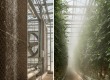
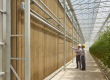
This common method involves pulling hot outside air through large, water-saturated cellulose pads located on one wall of the greenhouse. Exhaust fans on the opposite wall create negative pressure, ensuring a constant flow of air. As the air passes through the wet pads, water evaporates, cooling the air before it enters the crop zone.
- Best Suited For: Inland areas like Al Ain with a large wet-bulb depression. They are relatively cost-effective to install and operate.
- Limitations: Performance drops sharply as external humidity rises, making them less effective in coastal Abu Dhabi or Dubai during peak summer. They also create a temperature gradient, with the area near the pads being coolest.
High-Pressure Fogging Systems
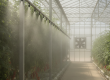
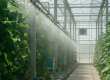
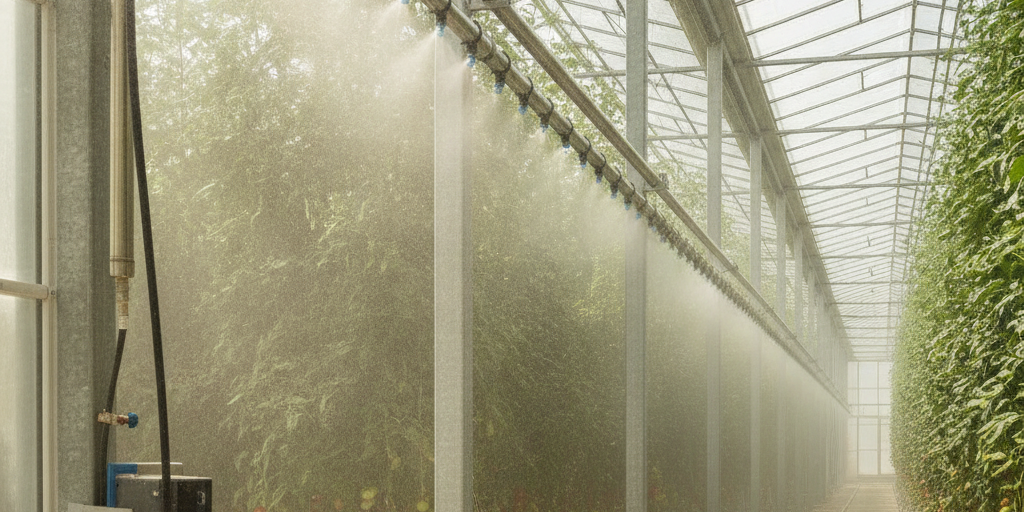
These systems use a high-pressure pump (typically operating above 70 bar or 1000 PSI) to atomize water into micro-droplets through specialized nozzles. These fine droplets (fog) are suspended in the air and
Frequently asked questions
Why can't I use the same greenhouse cooling system in Al Ain and Dubai?
Dubai's coastal climate has high humidity, which severely limits the effectiveness of evaporative cooling. Al Ain's dry inland climate is ideal for these systems. Using an Al Ain design in Dubai would lead to insufficient cooling and potential crop loss.
What is wet-bulb temperature and why is it crucial for UAE greenhouses?
Wet-bulb temperature measures the lowest temperature achievable through water evaporation. It indicates how dry the air is. The difference between the standard (dry-bulb) temperature and the wet-bulb temperature determines the cooling potential, making it the most critical metric for system design in the UAE.
Does high-pressure fogging work better than pad-and-fan in coastal UAE?
High-pressure fogging often has an advantage in humid coastal areas. Its finer droplets can evaporate more efficiently in moist air compared to pad systems. However, the best solution might be a hybrid approach combined with excellent ventilation, based on a full engineering analysis.
What is the biggest mistake when designing cooling for a desert greenhouse?
The most significant mistake is using generic or inaccurate climate data. Designing a system for an Al Ain project using Dubai's weather data, or vice versa, will result in a system that is either undersized and ineffective or oversized and inefficient. Always insist on using location-specific design data.
Discuss your greenhouse climate project with Green Climate: Contact our team.