Successfully growing crops in the United Arab Emirates requires robust control over the greenhouse environment, with cooling being the most critical and energy-intensive challenge. While several technologies exist, evaporative cooling methods like pad-and-fan or high-pressure fogging are common due to their relative efficiency. However, their effectiveness is governed by a fundamental law of physics tied to the wet bulb temperature greenhouse cooling potential, a factor that varies significantly across the UAE.
Understanding this concept is not just an academic exercise; it is the most important step in system selection, realistic expectation setting, and avoiding costly investments in undersized or inappropriate cooling equipment. This guide explains what wet-bulb temperature is, how it dictates cooling performance, and what it means for designing systems in different Emirates.
The Critical Role of Climate Data in UAE Greenhouse Design
The UAE’s climate presents a dual challenge: extremely high air temperatures (dry-bulb temperature) and, in many key agricultural zones, high ambient humidity. This combination is particularly demanding for evaporative cooling technologies. A system that performs well in a dry desert climate may be insufficient in a humid coastal one, even if the air temperatures are identical.
This is why a one-size-fits-all approach to greenhouse cooling is destined to fail. A design for a farm in Al Ain, with its hot and relatively dry inland climate, will have a fundamentally different performance potential than an identical setup in a coastal area like Sharjah or Ras Al Khaimah, where the air is often laden with moisture from the Arabian Gulf. Relying on generic data or assumptions can lead to systems that fail to protect crops during the most critical summer months.
What Are Dry-Bulb and Wet-Bulb Temperatures?
To properly engineer a cooling system, we must distinguish between two key measurements:
- Dry-Bulb Temperature (DBT): This is the temperature of the air measured by a standard thermometer, shielded from radiation and moisture. It’s the temperature we typically hear in weather forecasts.
- Wet-Bulb Temperature (WBT): This is the lowest temperature that can be reached by the evaporation of water into the air. It is measured with a thermometer whose bulb is covered by a wet sock with air moving over it. The drier the air, the faster the evaporation and the lower the wet-bulb temperature will be compared to the dry-bulb.
The difference between the dry-bulb and wet-bulb temperature is known as the wet-bulb depression. This value represents the theoretical maximum cooling potential through evaporation. A large depression means significant cooling is possible; a small depression means cooling potential is very limited.
How Evaporative Cooling Systems Work
Evaporative cooling technologies leverage the principle that water absorbs a significant amount of energy (heat) when it changes from a liquid to a gas (vapor). The two most common systems in greenhouses are pad-and-fan and high-pressure fogging.
Pad-and-Fan Cooling Systems
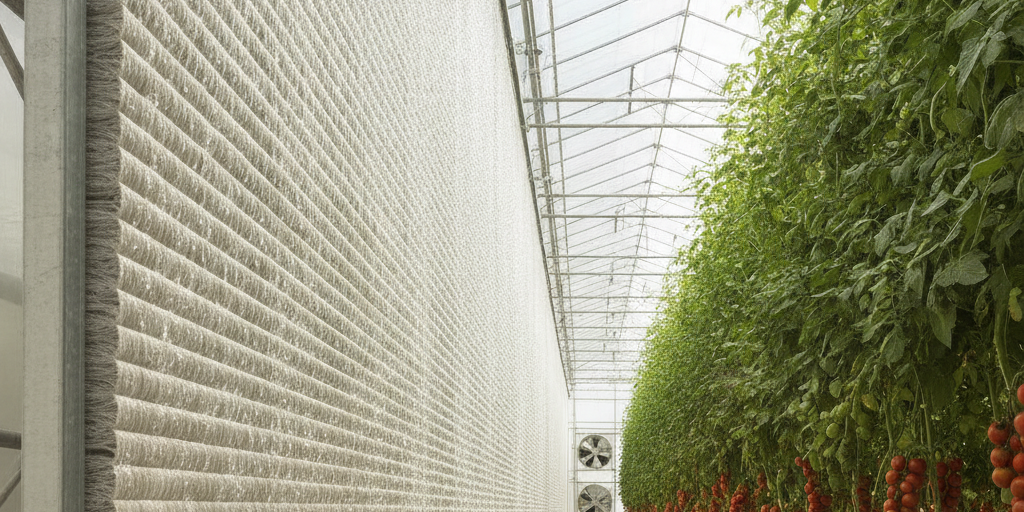
In a pad-and-fan system, large exhaust fans are placed at one end of the greenhouse, and a wall of porous, absorbent pads is installed at the opposite end. A pump circulates water to keep these pads saturated.
The fans create negative pressure, pulling hot, dry outside air through the wet pads. As the air passes through, water on the pads evaporates, absorbing heat from the air. This cooled, humidified air is then drawn across the length of the greenhouse, removing heat from the structure and crops before being exhausted by the fans. The performance of these systems depends on the pad material, thickness, air speed, and, most importantly, the outdoor air properties.
High-Pressure Fogging Systems
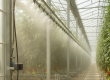
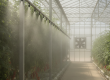
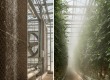
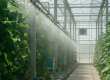
High-pressure fogging operates on the same principle but distributes the water differently. A high-pressure pump (typically operating above 70 bar or 1000 PSI) forces water through specially designed nozzles, creating a fog of micro-droplets so fine they are typically smaller than 10 microns.
These droplets are suspended in the greenhouse air and evaporate before they can settle on plant surfaces. This process, known as flash evaporation, directly cools the air within the greenhouse. Well-designed high-pressure greenhouse fogging systems can achieve highly uniform cooling and humidification when properly integrated with ventilation and control systems.
The Unbreakable Limit: Evaporative Efficiency and Wet-Bulb Approach
No matter how well-designed an evaporative cooling system is, it cannot cool the air below the wet-bulb temperature of the incoming air. The actual temperature of the air leaving the cooling pad or in a fogged zone will be somewhere between the initial dry-bulb and the wet-bulb temperature.
The effectiveness of a system in reaching this limit is called its evaporative efficiency. This is expressed as a percentage. For example, a pad-and-fan system with 85% efficiency will lower the dry-bulb temperature by 85% of the wet-bulb depression.
The formula to estimate the outlet air temperature is:
Outlet Temp = Inlet DBT – (Efficiency % × (Inlet DBT – Inlet WBT))
This calculation is fundamental to any greenhouse cooling design and demonstrates why accurate climate data is non-negotiable.
Coastal vs. Inland UAE: A Critical Design Distinction
The impact of wet-bulb temperature is best illustrated by comparing two hypothetical scenarios in the UAE on a hot summer afternoon.
Scenario 1: Inland Location (e.g., Al Ain)
- Outdoor Conditions: Dry-Bulb = 46°C, Wet-Bulb = 24°C
- Wet-Bulb Depression: 46°C – 24°C = 22°C
- Cooling Potential: With an 85% efficient pad system, the theoretical air temperature entering the greenhouse would be: 46 – (0.85 × 22) = 27.3°C. This represents a significant temperature drop.
Scenario 2: Coastal Location (e.g., Dubai)
- Outdoor Conditions: Dry-Bulb = 46°C, Wet-Bulb = 32°C
- Wet-Bulb Depression: 46°C – 32°C = 14°C
- Cooling Potential: Using the same 85% efficient system, the theoretical air temperature entering the greenhouse would be: 46 – (0.85 × 14) = 34.1°C.
This comparison clearly shows that the same cooling system provides far less cooling in the humid coastal environment. An investor assuming the Al Ain performance level for a Dubai project would be left with a greenhouse that overheats, potentially leading to crop failure.
The Challenge of High Humidity
A key outcome of all evaporative cooling is an increase in relative humidity. In a dry inland climate, this is often beneficial for crops. However, in a humid coastal climate, starting with already moist air and adding more water can push humidity levels above 90-95%. Such conditions can inhibit plant transpiration and create an ideal environment for fungal diseases, requiring careful management through ventilation.
Essential Engineering Inputs for a Reliable Cooling Design
A professional cooling system design is not based on guesswork. It is an engineering process that requires specific data to calculate the total heat load of the greenhouse and select appropriately sized equipment. The heat load comes from solar radiation, conduction through the covering, and heat generated by equipment like greenhouse lighting systems.
To begin a preliminary assessment for a project in the UAE, the following information is essential:
- Project Location: The specific emirate and city are needed to source accurate design climate data (DBT and WBT).
- Greenhouse Dimensions: Length, width, and gutter height are required to calculate air volume and surface areas.
- Covering Material: The type of plastic film, polycarbonate, or glass significantly affects the solar heat gain.
- Crop Type: Different crops have different optimal temperature and humidity ranges. This is especially important for hydroponic greenhouse systems where environmental control is paramount.
- Water Analysis: A recent analysis of the available water source is crucial. High salinity or hardness can rapidly clog or damage cooling pads and fog nozzles, leading to system failure.
- Electrical Supply: The available voltage, phase, and capacity determine the size of fans and pumps that can be supported.
Operational Costs: Water, Energy, and Maintenance
While often having a lower initial investment than mechanical cooling, evaporative systems have significant operational considerations.
Water Consumption
Evaporation consumes large volumes of water. This is a direct operational cost and a critical resource consideration in the UAE. The system must be designed to operate efficiently, and the water source must be reliable. Water treatment, such as reverse osmosis (RO), may be necessary if the source water quality is poor, adding to both capital and operational expenses.
Energy Consumption
Pad-and-fan systems require energy to run large ventilation fans continuously during hot periods. High-pressure fog systems require energy for their high-pressure pumps. The total energy consumption depends on the required airflow rate (for fans) or water flow rate (for pumps), which is determined by the heat load calculation.
Maintenance Requirements
Proper maintenance is essential for sustained performance.
- Pads: Must be cleaned regularly to prevent algae growth and salt buildup. Over time, they will degrade and require replacement every few years.
- Nozzles: Fogging nozzles have very small orifices and can clog easily without proper filtration. They require regular inspection and cleaning.
- Pumps & Filters: All pumps and water filtration systems require routine service according to manufacturer specifications to ensure reliability.
A Buyer’s Checklist for UAE Greenhouse Cooling
Before investing in a cooling system for a UAE-based project, use this checklist to ensure you are making an informed decision:
- Define Your Location-Specific Climate: Have you obtained the 1% or 5% summer design dry-bulb and mean coincident wet-bulb temperatures for your exact project site from a reliable source? Do not use generic data from a major city if your farm is located elsewhere.
- Confirm Your Water Quality: Have you performed a comprehensive water analysis for Total Dissolved Solids (TDS), hardness, and specific mineral content? Share this report with your system supplier.
- Set Realistic Temperature Targets: Do you understand the minimum achievable temperature based on your design wet-bulb temperature and system efficiency? Do not expect an evaporative system to perform like an air conditioner.
- Calculate the Full Heat Load: Has a proper heat load calculation been performed based on your greenhouse’s specific size, covering, and orientation? This determines the required airflow (CFM) or fogging rate (L/hr).
- Plan for Maintenance: Have you budgeted for the ongoing costs and labor associated with cleaning, parts replacement, and system servicing?
Conclusion: Engineering for Success
The wet bulb temperature is the absolute baseline for greenhouse cooling performance using evaporative methods. Its proper application separates successful, high-yield greenhouses from those that struggle through the UAE’s demanding summer. While the principles are universal, the local climate variations between coastal and inland regions require a tailored engineering approach.
By starting with accurate climate data, understanding the physical limitations of the technology, and providing a complete set of project inputs, you can work with an engineering partner to design a cooling system that is effective, reliable, and properly matched to your crop and location. To explore a wide range of agricultural engineering solutions, you can review some of our past Green Climate projects.
To begin the design process for your project, we invite you to request a preliminary UAE greenhouse cooling assessment. Please provide your project location, greenhouse dimensions, crop type, water analysis, and available electrical information for an initial evaluation.
Frequently asked questions
What is the main difference between dry-bulb and wet-bulb temperature?
Dry-bulb is the ambient air temperature measured by a regular thermometer. Wet-bulb is the lowest temperature air can be cooled to by evaporation and is measured with a wetted sensor. The difference between them indicates the potential for evaporative cooling.
Why can't my evaporative cooler cool below the wet-bulb temperature?
Evaporative cooling works by converting liquid water to vapor, which absorbs heat from the air. The wet-bulb temperature represents the point at which the air is fully saturated with water vapor (100% relative humidity) and can absorb no more moisture. Therefore, no further evaporative cooling can occur.
Is evaporative cooling effective everywhere in the UAE?
No, its effectiveness varies greatly. In dry, inland areas like Al Ain, it is very effective due to low humidity. In humid, coastal areas like Dubai or Sharjah, its performance is significantly limited because the outdoor air is already moist, reducing the potential for evaporation.
How much water does an evaporative cooling system use?
Water consumption depends directly on the heat load being removed from the greenhouse. On hot, dry days, consumption will be very high. A proper engineering design is required to estimate the water demand based on greenhouse size, location, and operational hours.
What happens if I use saline water in my cooling system?
Using water with high salt or mineral content will cause rapid buildup on cooling pads, reducing airflow and efficiency. In fogging systems, it will quickly clog the fine nozzles, causing system failure. This is why a water analysis and potential pre-treatment are essential.
Discuss your greenhouse climate project with Green Climate: Contact our team.