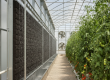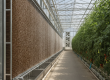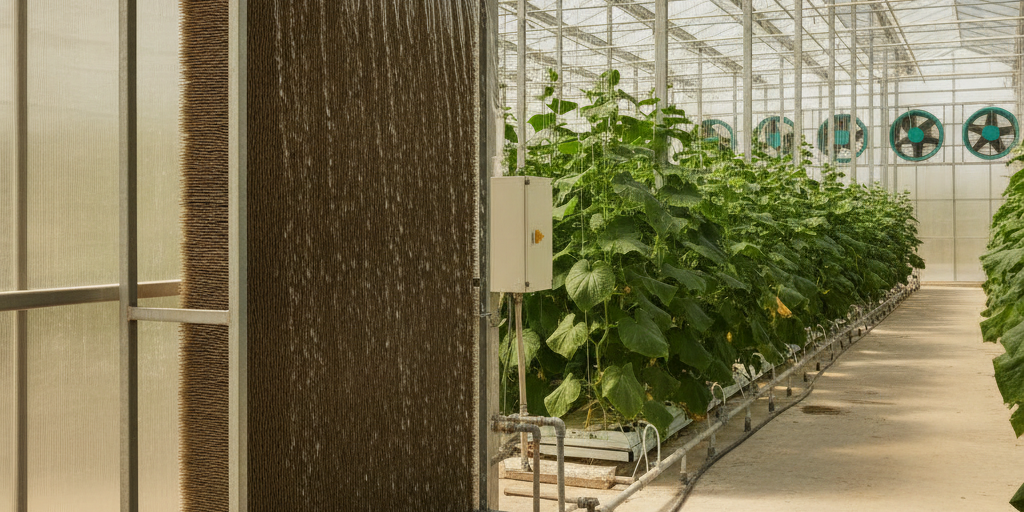
Evaporative cooling systems are a cornerstone of greenhouse climate control in many hot, dry regions. However, for growers in the United Arab Emirates, particularly in coastal areas, relying solely on this technology can lead to significant challenges. The effectiveness of evaporative cooling in the humid climate of the UAE is fundamentally limited by physics, specifically the relationship between heat, humidity, and the air’s capacity to absorb more water vapor.
When outdoor relative humidity is high, the air is already near its saturation point. This dramatically reduces the rate of evaporation, and therefore, the amount of cooling that can be achieved. This guide explains the science behind this limitation, the critical role of wet-bulb temperature, and the strategic considerations for designing a robust cooling system for your UAE greenhouse project.
The Core Principle: How Evaporative Cooling Works
All evaporative cooling technologies, including both pad-and-fan and high-pressure fog systems, operate on a simple thermodynamic principle: when water evaporates, it changes from a liquid to a gas, a process that absorbs a significant amount of heat from the surrounding air. This absorption of energy is what causes the air temperature to drop. The key factor is that evaporation must occur for cooling to take place.
To understand the limits of this process, it’s essential to be familiar with three related climate parameters:
- Dry-Bulb Temperature: This is the standard air temperature measured by a regular thermometer, unaffected by the moisture in the air. It’s the temperature you typically hear in a weather forecast.
- Wet-Bulb Temperature: This is the lowest temperature that can be reached through the evaporation of water alone. It is measured with a thermometer that has its bulb wrapped in a wet cloth. As water evaporates from the cloth, it cools the bulb. In dry air, evaporation is rapid, and the wet-bulb temperature is much lower than the dry-bulb. In humid air, evaporation is slow, and the wet-bulb temperature is close to the dry-bulb temperature.
- Relative Humidity (RH): This is the amount of moisture in the air, expressed as a percentage of the maximum amount of moisture the air could hold at that same temperature. At 100% RH, the air is fully saturated, and no more evaporation can occur.
The difference between the dry-bulb and wet-bulb temperatures is known as the wet-bulb depression. This value represents the maximum potential for evaporative cooling. A large wet-bulb depression (typical of hot, dry climates) means there is significant cooling potential. A small wet-bulb depression (typical of hot, humid climates) means there is very little.
UAE’s Climate Challenge: Coastal Humidity vs. Inland Aridity
The UAE’s climate is not uniform. A cooling strategy that works in Al Ain may be insufficient in Dubai or Sharjah during the most challenging summer months. This geographical difference is the primary reason why a one-size-fits-all approach to greenhouse cooling is destined to fail.
Coastal Regions (Dubai, Abu Dhabi, Sharjah)
These areas are heavily influenced by the Arabian Gulf. During the summer, from June to September, daytime temperatures can exceed 45°C while relative humidity often climbs above 60-70%, particularly in the late afternoon and evening. Under these conditions, the wet-bulb temperature can rise to 32-35°C. With such a small wet-bulb depression, the cooling capacity of any evaporative system is severely restricted, regardless of its size or design.
Inland Regions (Al Ain)
Located further from the coast, inland areas like Al Ain typically experience lower humidity levels for much of the year. This results in a larger wet-bulb depression, making evaporative cooling a more viable and effective primary cooling method. However, even inland regions can experience periods of increased humidity, and designers must account for these worst-case scenarios to protect crops.
Calculating Real-World Performance
No evaporative cooling system is 100% efficient. The actual temperature drop you can achieve depends on the system’s
Frequently asked questions
Why does high humidity stop evaporative cooling from working well?
High humidity means the air is already saturated with water vapor. Evaporative cooling works by adding more vapor to the air through evaporation, a process which is severely limited when the air cannot hold any more moisture, thus reducing the cooling effect.
What is the theoretical minimum temperature I can reach with evaporative cooling?
The theoretical limit is the outdoor wet-bulb temperature. In practice, a well-designed system can cool the incoming air to within a few degrees of this value, typically achieving 75-85% of the total possible temperature drop (the wet-bulb depression).
Are fogging systems better than pad-and-fan systems in humid UAE conditions?
Both are forms of evaporative cooling and are limited by the same laws of physics. While high-pressure fogging can offer more uniform temperature distribution inside the greenhouse, it cannot overcome the fundamental performance drop caused by a high outdoor wet-bulb temperature.
What is the best cooling solution for a coastal UAE greenhouse?
There is no single 'best' solution, as the optimal design depends on the crop, budget, and production goals. The most robust approach is often a hybrid system that combines high-efficiency ventilation, external and internal shading, and an evaporative system for use during drier periods. For high-value or sensitive crops, this may need to be supplemented with mechanical cooling.
Discuss your greenhouse climate project with Green Climate: Contact our team.