Receiving a greenhouse cooling proposal UAE investors and growers can trust is the first step toward a successful project. A professional proposal is not just a price list; it is a detailed engineering document that defines the system’s capabilities, scope, and limitations based on the specific and demanding climate of the United Arab Emirates. Understanding its key components is crucial for making a sound investment.
This guide provides a comprehensive checklist for evaluating technical proposals for greenhouse cooling systems. It will help you compare offers accurately, identify potential risks, and ensure the proposed solution is genuinely suited to your operational goals and local environmental conditions.
The Unique Challenge: UAE’s Climate Demands Precision
Effective greenhouse cooling in the UAE is a significant engineering challenge. The primary obstacle is not just extreme heat but also the combination of high temperatures with high humidity, particularly in coastal regions. A proposal that fails to account for these local variations is fundamentally flawed.
It is essential to distinguish between different climate zones within the UAE. For instance, coastal areas like Dubai and Abu Dhabi experience high ambient humidity, which can limit the effectiveness of purely evaporative cooling methods. In contrast, inland regions like Al Ain have a hotter, drier climate where evaporative systems can perform more efficiently. A credible proposal must specify the exact location and use corresponding climate data for its calculations.
Why Generic Solutions Fail
Applying a one-size-fits-all approach to greenhouse cooling in the Gulf region often leads to underperformance, high energy consumption, and potential crop loss. A supplier must demonstrate their understanding of these nuances. The proposal should serve as evidence that the system has been engineered for your specific site, not just copied from a project in a different climate.
Core Components of a Professional Technical Proposal
A thorough and transparent proposal allows you to make an informed decision. Look for a clear and detailed breakdown of the following sections. A lack of detail in any of these areas should be considered a red flag.
1. Design Basis and Climate Assumptions
This is the most critical section of the entire document. It is the foundation upon which all calculations and equipment selections are built. Without a clearly stated design basis, any performance claims are meaningless.
Your proposal must explicitly state:
- Outdoor Design Conditions: The specific maximum outdoor dry-bulb temperature (°C) and corresponding wet-bulb temperature (°C) or relative humidity (%) used for calculations. These values determine the theoretical limit of evaporative cooling performance.
- Target Indoor Conditions: The desired indoor temperature and relative humidity that the system is designed to achieve under the specified outdoor conditions. This should be presented as a realistic target, not an absolute guarantee.
- Ventilation and Air Exchange Rate: The calculated volume of air to be moved through the greenhouse per minute or hour. This is often expressed in air changes per hour (ACH) or cubic meters per hour (m³/h).
- Solar Radiation Load: The assumed solar energy (in W/m²) entering the greenhouse, which is a major source of heat gain. This is influenced by the covering material and any shading systems.
2. Detailed Equipment Schedule
A simple line item like “Cooling System” is insufficient. The proposal should include a comprehensive list of all major components with makes, models, quantities, and key technical specifications. This allows you to verify the quality and suitability of the equipment being offered.
Key items to look for include:
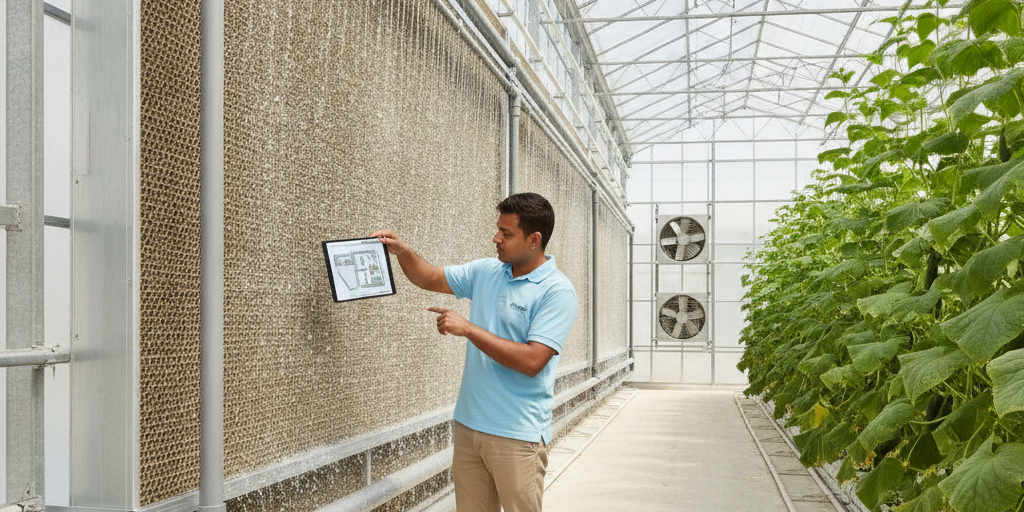
- Exhaust Fans: Manufacturer, model number, diameter, airflow capacity (m³/h) at a specific static pressure (Pa), motor power (kW), and efficiency ratings.
- Evaporative Cooling Pads: Material (e.g., 7090 flute angle cellulose), thickness (e.g., 150 mm), height, and total length.
- Water Distribution System: Pump model and capacity, pipe material and diameters, and details of the water sump or tank.
- High-Pressure Fog System (if applicable): Pump unit pressure (bar) and flow rate (L/min), nozzle type and orifice size, nozzle quantity and spacing, and filtration system specifications.
- Control System: Details of the climate controller, sensors (temperature, humidity), and electrical panel components.
3. Scope of Supply and Services
This section defines exactly what you are paying for and what you are not. Ambiguity here is a common source of project disputes and cost overruns. The scope should be clearly divided into supply, installation, and commissioning.
A professional proposal will clearly state whether the following are included or excluded:
- Supply Terms: Are prices Ex-Works (from the factory), FOB (loaded onto a ship), or CIF (including shipping and insurance to a UAE port)?
- Civil Works: Who is responsible for concrete foundations for pads and fans, water tank bases, and any required trenching? This is typically the client’s responsibility.
- Installation: Does the price include the full mechanical and electrical installation of the equipment on site?
- Commissioning and Training: Is the final testing, system startup, and training of your operational staff included in the offer?
- Utilities: The proposal should state that the client is responsible for providing adequate electrical power and water supply to the connection points.
4. Performance Projections and Limitations
A reputable supplier will provide realistic performance expectations and be transparent about the system’s limitations. Be wary of guarantees of a fixed indoor temperature regardless of outside conditions.
Important: The performance of an evaporative cooling system is directly tied to the outdoor wet-bulb temperature. The system can, in theory, cool the air down to the wet-bulb temperature, but in practice, the final temperature will be several degrees higher. The proposal should state the expected temperature *reduction* or the target indoor temperature *relative to the stated design conditions*.
A Buyer’s Checklist for Evaluating Proposals
When you have multiple proposals on your desk, use this checklist to compare them systematically. An offer that ticks all these boxes is likely from a professional and experienced engineering firm.
- Is the Design Basis Clear?: Does the proposal specify the exact outdoor dry-bulb and wet-bulb temperatures it is designed for?
- Is the Location Specific?: Does the proposal acknowledge the specific climate of your emirate (e.g., coastal Abu Dhabi vs. inland Al Ain)?
- Is the Equipment List Detailed?: Can you see the exact make, model, and quantity of every major component like fans and pumps?
- Is the Scope of Work Unambiguous?: Is it perfectly clear what is included and, more importantly, what is excluded from the price?
- Are Performance Claims Realistic?: Does the supplier explain performance based on outdoor conditions, or do they make unrealistic guarantees?
- Are Power and Water Needs Stated?: Does the proposal specify the total electrical load (kW) and estimated water consumption (L/h)?
- Is a Water Analysis Required?: Does the supplier mention the need for a water quality analysis, especially for fogging systems or in areas with high water salinity?
- Are Commercial Terms Complete?: Are the payment schedule, delivery timeline, warranty period, and proposal validity clearly defined?
Information You Must Provide for an Accurate Proposal
To receive a high-quality, engineered proposal, you must provide the supplier with detailed information about your project. The more data you can share, the more accurate and reliable the cooling system design will be. Be prepared to provide the following:
- Project Location: The specific emirate and nearest city.
- Greenhouse Details: Provide drawings or at least the precise width, length, and height (to the gutter and to the ridge) of each greenhouse block.
- Covering Material: Specify the type of covering (e.g., Polycarbonate, Glass, Polyethylene film) as it affects heat gain.
- Crop Type: Different crops have different optimal temperature and humidity requirements. This is crucial for designing the control strategy.
- Existing Infrastructure: Detail any existing ventilation, shading, or cooling systems.
- Water and Power: Provide a water quality analysis report and confirm the available voltage, phase, and power capacity at the site.
- Project Scope: Clearly state whether you require supply only, or a full turnkey solution including installation and commissioning.
Beyond the Initial Price: Operational Considerations
The cheapest proposal is not always the best value. A well-engineered system may have a higher initial cost but save you significantly in the long run through better performance and efficiency. Consider the total cost of ownership.
Water Quality and Consumption
Evaporative cooling systems consume significant amounts of water. Furthermore, the high Total Dissolved Solids (TDS) common in UAE water sources can lead to scaling, which clogs cooling pads and fog nozzles, drastically reducing efficiency. A good proposal should acknowledge this and may recommend or require a water treatment system.
Energy Consumption
The fans and pumps in a cooling system are major energy consumers. The proposal should provide an estimate of the total connected electrical load in kilowatts (kW). Compare the energy efficiency of the proposed fans and pumps, as a more efficient model can lead to substantial operational savings over the life of the system.
Maintenance Requirements
All cooling systems require regular maintenance. This includes cleaning pads to prevent algae and salt buildup, checking and cleaning water filters, and servicing pumps and fans. Understand the maintenance schedule and factor these operational tasks and costs into your business plan.
Conclusion: Your Proposal is Your Project’s Blueprint
A detailed, transparent, and technically sound greenhouse cooling proposal for your UAE farm is more than a sales document—it is the engineering blueprint for your crop’s environment. By demanding clarity on design conditions, equipment specifications, and scope of work, you protect your investment and set your project up for success.
Take the time to scrutinize every detail. A supplier who provides a comprehensive proposal is a partner who understands the technical challenges of growing in the Gulf and is committed to delivering a solution that works. For a detailed review of your project’s specific needs, we invite you to request a greenhouse cooling assessment from our engineering team.
Frequently asked questions
Why is stating outdoor design conditions (dry-bulb/wet-bulb) so important in a UAE proposal?
Outdoor design conditions determine the maximum possible cooling effect of any evaporative system. A proposal without this data has no verifiable performance basis, making it impossible to judge if the system is adequately sized for the UAE's extreme summer conditions.
Can a supplier guarantee my greenhouse will always be 25°C?
No, and you should be cautious of any supplier who makes such a guarantee for an evaporative cooling system. The achievable indoor temperature is always relative to the outdoor temperature and humidity. A professional proposal will define the expected indoor conditions under a specific, stated set of outdoor conditions.
What is the biggest mistake when comparing greenhouse cooling proposals?
The biggest mistake is comparing prices without first comparing the technical specifications and design basis. A cheaper offer may use lower-quality equipment, be undersized for peak conditions, or have significant hidden costs in the 'exclusions' section. Always compare the engineering details first.
Should the proposal include a water treatment plan?
Given the often poor water quality in the region, a professional supplier should at least request a water analysis. For high-pressure fog systems, water treatment (like reverse osmosis) is mandatory. For pad systems, a proposal should address the risk of scaling and may recommend treatment to ensure long-term efficiency.
Discuss your greenhouse climate project with Green Climate: Contact our team.