Achieving year-round greenhouse production in the UAE is a significant engineering challenge, but it is technically possible with the right strategy and technology. Success depends on a carefully designed cooling system that accounts for extreme summer heat and humidity, combined with strategic crop selection and a clear understanding of the economic trade-offs. It is not a one-size-fits-all solution; it requires a tailored approach based on location, crop, and business goals.
This guide explores the key limitations, design choices, and operational factors that investors and growers must consider to make year-round cultivation a reality.
The Core Challenge: The UAE’s Extreme Summer Climate
The primary obstacle to continuous production is the UAE’s summer climate, characterized by intense solar radiation and high ambient temperatures often exceeding 45°C. However, temperature alone is not the full story. The critical factor for many cooling technologies is high humidity, especially in coastal areas.
This combination of heat and humidity creates an environment where plants can quickly experience stress, leading to reduced growth, lower yields, and increased susceptibility to disease. Effectively managing the internal greenhouse climate during these months is the most energy-intensive and costly aspect of the operation.
Coastal vs. Inland: Why Location Is Critical for Cooling Design
The UAE’s geography presents two distinct climate challenges that demand different engineering solutions. Treating locations like Dubai and Al Ain as the same can lead to undersized systems and crop failure. The key difference lies in the air’s moisture content, which directly impacts the effectiveness of evaporative cooling.
Coastal Regions (Dubai, Abu Dhabi, Sharjah)
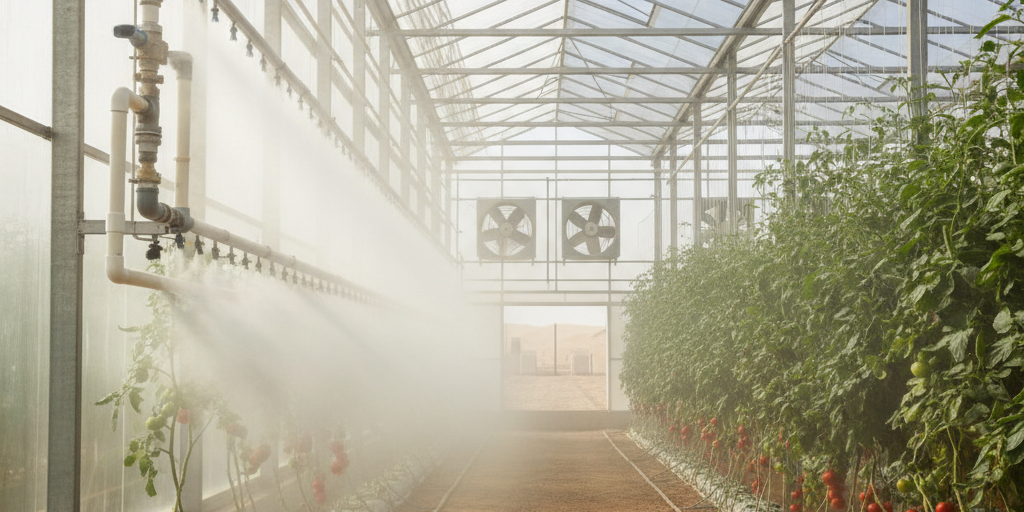
Coastal areas experience prolonged periods of high humidity, particularly from June to September. During these months, the outdoor air is already saturated with moisture. This reduces the potential for evaporative cooling, a process that relies on water evaporating to absorb heat. The wet-bulb temperature, a measure of the lowest temperature achievable through evaporation, can be very close to the actual air temperature, limiting the cooling effect of standard systems.
Inland Regions (Al Ain)
Inland desert locations like Al Ain typically have much lower humidity. This creates a large difference between the dry-bulb (actual air) temperature and the wet-bulb temperature. This significant
Frequently asked questions
Is year-round greenhouse farming technically possible in the UAE's summer?
Yes, it is technically possible with advanced and correctly sized cooling systems. However, the effectiveness and operational cost depend heavily on the location's humidity and the specific crop's heat tolerance.
Does technical feasibility guarantee profitability for year-round production?
Not necessarily. The high energy and water costs of intensive summer cooling can make year-round production economically unviable for some crops. A thorough feasibility study comparing operational costs to crop value is essential.
Which crops are better suited for year-round production in the UAE?
Heat-tolerant crops and varieties, such as certain types of tomatoes, cucumbers, and peppers, are more suitable. High-value but sensitive crops like leafy greens or berries may require more sophisticated and costly hybrid or mechanical cooling systems to survive the summer.
What is the main difference between cooling a greenhouse in Dubai versus Al Ain?
Dubai's coastal climate has high humidity, which severely limits the effectiveness of evaporative cooling technologies. Al Ain's drier inland climate has a much greater potential for evaporative cooling, allowing for a larger temperature drop with the same systems.
Discuss your greenhouse climate project with Green Climate: Contact our team.