Successfully growing high-value crops in the United Arab Emirates requires precise management of extreme environmental conditions. A single cooling method is often insufficient to handle the intense solar radiation and high ambient temperatures. A properly engineered hybrid greenhouse cooling UAE strategy, which combines multiple technologies, provides the resilience and control needed to maintain optimal growing conditions year-round.
This approach isn’t just about installing more equipment; it’s about an intelligent control system that deploys the right tool at the right time to manage temperature and humidity efficiently.
The Unique Climate Challenge in the UAE
Greenhouse operators in the UAE face a dual challenge that dictates cooling system design. The first is the extremely high solar heat load, which can quickly raise internal temperatures far beyond what crops can tolerate. The second is the significant variation in ambient humidity between different locations.
Coastal areas like Dubai and Sharjah often experience high humidity, which limits the effectiveness of purely evaporative cooling methods. In contrast, inland regions such as Al Ain have a drier climate where evaporative systems can perform more effectively. A robust cooling strategy must be able to adapt to these different climatic conditions.
What is a Hybrid Greenhouse Cooling System?
A hybrid cooling system is an integrated solution that combines two or more cooling technologies, managed by a central climate controller. The goal is to leverage the strengths of each component while mitigating its weaknesses, resulting in a more effective and energy-efficient system overall.
The core of a hybrid system is its control strategy. The controller uses data from internal and external sensors (temperature, humidity, solar radiation) to activate the most appropriate cooling method—or combination of methods—to maintain the target climate setpoints.
Core Components of a Hybrid Strategy
A typical hybrid system in the UAE integrates the following technologies:
- Shading Screens: These are often the first line of defense. Retractable screens reduce the amount of solar radiation entering the greenhouse, directly lowering the heat load on the plants and the structure. This reduces the work required from active cooling systems.
- Ventilation: Natural ventilation through roof and side vents helps to exhaust trapped hot air. When this is insufficient, mechanical exhaust fans are used to force air exchange, providing a baseline level of cooling.
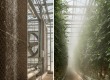
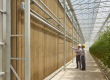
- Pad-and-Fan Evaporative Cooling: This system draws hot, dry outside air through water-saturated cellulose pads. The water evaporates, cooling the air before it enters the greenhouse. It is highly effective in low-humidity conditions but its performance drops as external humidity rises.
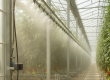
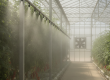
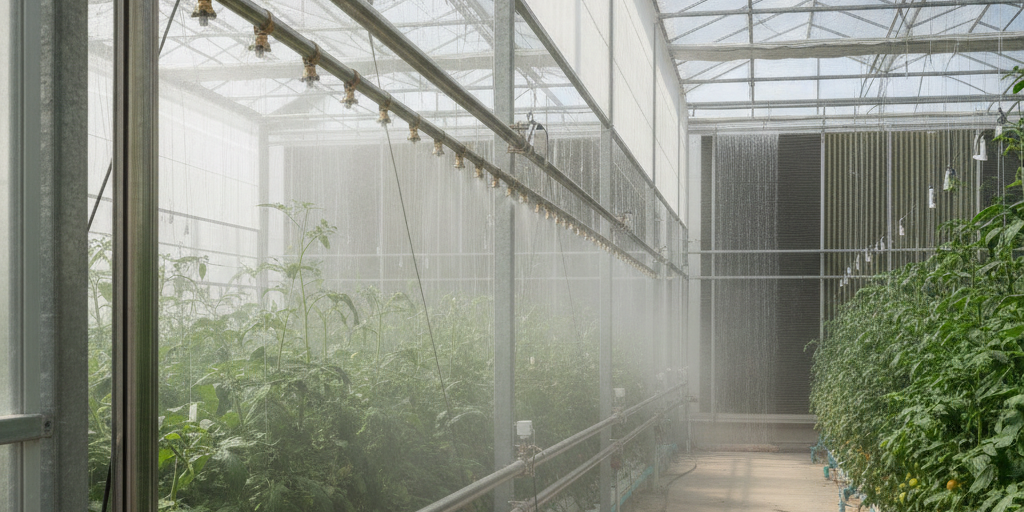
- High-Pressure Fogging: This method uses a high-pressure pump to atomize water into micro-droplets that flash-evaporate in the air. This process absorbs heat and cools the environment, and can also be used to precisely manage humidity levels. High-pressure greenhouse fogging systems require high-quality water to prevent nozzle clogging.
Designing the Control Sequence: How It Works in Practice
The intelligence of a hybrid system lies in its sequential and adaptive operation. The climate controller is programmed with a series of stages, activating more energy-intensive systems only when necessary.
A typical sequence might look like this:
- Stage 1 – Radiation Control: As solar radiation and temperature rise, the controller first deploys the retractable shade screen to block a percentage of the incoming heat.
- Stage 2 – Natural & Mechanical Ventilation: The controller opens roof vents to release hot air. If temperature continues to rise, it activates exhaust fans to increase air exchange.
- Stage 3 – Active Evaporative Cooling: This is where the system adapts to local conditions. The controller evaluates the external wet-bulb temperature—a measure of both heat and humidity.
Scenario 1: A Hot, Dry Day in Al Ain
On a day with high temperatures and low humidity, the pad-and-fan system is the most efficient choice. The controller will activate the pad pumps and exhaust fans to draw a large volume of significantly cooled air through the greenhouse. Fogging might only be used in short bursts if the internal humidity drops below the target for the crop.
Scenario 2: A Hot, Humid Day in Dubai
When external humidity is high, the pad-and-fan system’s cooling potential is greatly reduced. Running it continuously could lead to excessively high humidity inside the greenhouse. In this case, the controller would prioritize the high-pressure fogging system, activating it in short, controlled cycles to provide cooling without over-saturating the air. Ventilation fans would run concurrently to manage air circulation and prevent stagnant, humid pockets.
Key Considerations for Design and Operation
When planning a hybrid cooling system for a UAE greenhouse, several factors must be evaluated to ensure performance and sustainability.
- Water Quality: High-pressure fogging demands reverse osmosis (RO) or demineralized water to prevent mineral deposits from clogging the fine nozzles. Pad systems are more tolerant but can suffer from algae growth and scale buildup if the water has high salinity, requiring regular maintenance.
- Energy Consumption: Pad-and-fan systems can be energy-intensive due to the large fans required to move significant air volumes. A hybrid strategy aims to reduce their runtime by using shading and fogging under specific conditions, thereby optimizing overall energy use.
- Capital Investment: The initial investment for a hybrid system is higher than for a single system due to the additional equipment and sophisticated control unit. However, this cost can be offset by improved crop quality, higher yields, and more efficient long-term operation.
- Maintenance: Each component has its own maintenance schedule. Fog nozzles need inspection, pads require cleaning and periodic replacement, and fans and pumps need regular servicing. A comprehensive maintenance plan is essential for system reliability.
Limitations and Common Misconceptions
It is crucial to have realistic expectations. A hybrid system is a powerful tool, but it operates within physical limits. Evaporative cooling, whether from pads or fog, cannot cool the air below the ambient wet-bulb temperature. The system’s effectiveness also depends heavily on the greenhouse structure itself—a poorly sealed or designed structure will compromise the performance of even the most advanced cooling system.
Simply installing more equipment is not the solution. The most critical component is the climate control system and the logic programmed into it. An improperly configured controller can lead to components working against each other, wasting energy and water and creating poor growing conditions.
Checklist for Your UAE Greenhouse Cooling Project
To receive an accurate preliminary design and quotation, it is important to provide detailed information about your project. Use this checklist as a guide:
- Project Location: Specify the emirate and nearest city to assess local climate data.
- Greenhouse Dimensions: Provide the width, length, and gutter height for each block.
- Covering Material: Note whether the greenhouse is covered with polycarbonate, glass, or polyethylene film.
- Crop Type: Different crops have different optimal temperature and humidity ranges.
- Existing Infrastructure: Detail any current ventilation or cooling equipment.
- Water Analysis: A recent water quality report is essential for selecting appropriate equipment.
- Electrical Supply: Specify the available voltage, phase, and total power capacity.
- Site Plans: Drawings and photographs help engineers understand the layout and potential challenges.
A Strategic Approach to Climate Control
Choosing the right cooling system for a greenhouse in the UAE is a critical investment decision. A hybrid approach, thoughtfully designed and precisely controlled, offers the most robust and adaptive solution. It moves beyond a one-size-fits-all model to a dynamic strategy that protects crop health, optimizes resource use, and maximizes production potential in one of the world’s most challenging agricultural environments.
To determine the best hybrid cooling configuration for your specific needs, a detailed engineering assessment is the necessary next step. Contact us to request a preliminary UAE greenhouse cooling assessment by providing your project’s location, dimensions, crop, water analysis, and other relevant site information.
Frequently asked questions
Why is a single cooling system often not enough for a UAE greenhouse?
A single system lacks the flexibility to handle the UAE's varied conditions. For example, a pad-and-fan system is inefficient during high-humidity coastal weather, while a fogging system alone may not provide enough air exchange. A hybrid system uses the best tool for the current conditions.
How does a hybrid cooling system decide which component to use?
The decision is made by a central climate controller based on real-time data from sensors. It primarily evaluates outdoor and indoor temperature and humidity (specifically the wet-bulb temperature) to determine whether pad cooling, fogging, or just ventilation is the most effective and efficient option at that moment.
Does a hybrid cooling system use more water and energy?
While it has a higher potential peak consumption, the goal of a hybrid system's control strategy is to reduce overall resource use. By using lower-energy options like shading first and choosing the most efficient cooling method for the conditions, it can often lead to lower long-term energy and water costs compared to a single system running inefficiently.
What is the most important part of a hybrid cooling system?
The most critical component is the integrated climate controller and its programming. The physical equipment (pads, fans, foggers) is important, but it's the intelligent control strategy that makes the system truly hybrid, ensuring all parts work together efficiently to achieve the desired climate.
Discuss your greenhouse climate project with Green Climate: Contact our team.