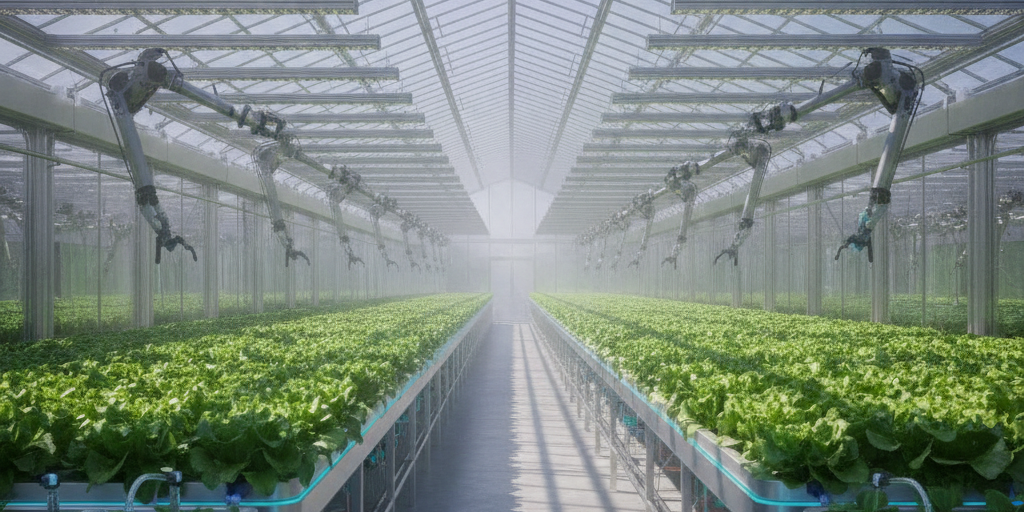
Transition from Traditional Automation to Smart Greenhouse Cultivation
Modern greenhouse cultivation has utilized automation systems for years to optimize plant growing conditions. Irrigation systems linked to timers, thermostat-controlled ventilation windows, or climate control based on simple sensors were significant steps in increasing efficiency in greenhouse cultivation. However, these systems typically operate reactively; meaning they trigger a pre-programmed action when a certain threshold is exceeded (e.g., when the temperature surpasses 25°C). While this approach solves immediate problems, it cannot predict, analyze complex relationships between different variables, or learn from the system to improve itself.
This is where artificial intelligence comes into play. AI-powered automation is among the most important greenhouse technology trends that elevate greenhouse cultivation to the next level. Systems no longer operate solely with “if this, then that” commands. Instead, they transform into an “intelligent” brain capable of making proactive decisions by analyzing real-time data from hundreds of sensors, historical information, and even external weather forecasts. This is a revolution that enables the greenhouse not just to be controlled, but to virtually manage itself.
Practical Applications of Artificial Intelligence in Greenhouse Cultivation
Artificial intelligence has evolved from an abstract concept into a tool that offers tangible benefits in our greenhouses. As Green Climate Technology, the primary areas we have observed and implemented in the field are:
1. Predictive Climate Control
The most critical element in a greenhouse is to create and maintain a microclimate specific to the plant’s needs. Artificial intelligence algorithms simultaneously process dozens of data points such as internal and external temperature, humidity, CO2 levels, light intensity, wind speed, and direction. By incorporating weather forecasts for the next few hours or days into the equation, it decides when and for how long to operate heating, cooling, or ventilation systems. For example, a system predicting the sun will suddenly appear after a cloudy day can open ventilation windows in advance to prevent the greenhouse from overheating. This proactive approach minimizes plant stress and significantly saves energy. Especially when integrated with properly designed greenhouse heating systems, a significant reduction in energy costs is observed.
2. Precision Irrigation and Nutrient Management (Fertigation)
Each plant’s water and nutrient requirements vary depending on its growth stage, climate conditions, and even the time of day. Artificial intelligence uses data from moisture sensors in the substrate or soil, plant leaf temperature, and drainage water analysis to create the optimal irrigation and fertilization schedule for each irrigation block. This means providing the plant with exactly what it needs, precisely when it needs it. As a result, water and fertilizer waste are prevented, the risk of root diseases is reduced, and yield quality improves. This technology is indispensable, especially for hydroponic greenhouse systems that require precise control of water and nutrients.
3. Disease and Pest Detection with Image Processing
One of the biggest challenges in greenhouse cultivation is detecting diseases and pests before they spread. AI-powered cameras and image processing software continuously scan the greenhouse. Trained with millions of plant images, these systems can detect even the slightest color changes, spots, or deformations caused by pests on leaves much earlier than the human eye. Early diagnosis reduces the use of chemical pesticides, allowing for biological or targeted interventions only in the affected area. This means both healthier products and more sustainable production.
4. Yield Prediction and Harvest Optimization
Knowing how much product will be harvested and when is critical for meeting market demands and planning logistics accurately. AI can make highly accurate yield predictions by analyzing plant growth rates, flowering and fruit set rates, and environmental conditions. By monitoring fruit size and color through cameras, it can determine the optimal harvest time. This data increases the efficiency of all operational processes, from labor planning to sales agreements.
Data-Driven Greenhouse Cultivation: Opportunities for Turkey
In regions like Antalya, the heart of greenhouse cultivation, efficiency is essential to gain a competitive advantage and cope with the challenges posed by the Mediterranean climate. Climatic stress factors such as extreme heat in summer or sudden cold spells in winter can be managed more effectively with data-driven smart systems. Artificial intelligence not only enables us to use resources (water, energy, fertilizer) more efficiently but also makes our greenhouses more resilient against the uncertainties brought by climate change. These technologies are no longer a luxury investment but are becoming a cornerstone of sustainable and profitable production.
A smart greenhouse is like a continuously learning organism. In each production cycle, it collects more data, refines its algorithms, and makes more accurate decisions for the next season. This is a hybrid approach that combines traditional agricultural knowledge based on experience with the power of big data. As Green Climate, in the greenhouses where we establish the engineering infrastructure, we aim to create a data-driven and intelligent ecosystem where all systems, from climate control to irrigation, communicate with each other.
Future Perspective: Fully Autonomous Greenhouses
The combination of artificial intelligence and robotic technologies brings us closer to the concept of “fully autonomous” or “lights-out farming” greenhouses. In this vision, all processes from planting to harvesting are managed by robots, with artificial intelligence serving as the brain of the entire operation. This future vision offers solutions to labor issues in agriculture while also having the potential to maximize efficiency and food security.
In conclusion, artificial intelligence is one of the most powerful tools for achieving efficiency, sustainability, and profitability goals in modern greenhouse cultivation. These greenhouse technology trends are making agriculture more precise, more predictable, and smarter. Adapting to this transformation will mean having a say in the agriculture of the future. If you would like to discover the most suitable automation and technology solutions for your greenhouse, contact our expert engineers and let’s take your project into the future together.
Frequently Asked Questions
Is establishing an AI-powered greenhouse system too costly?
The initial investment cost may be higher than traditional systems. However, thanks to the benefits provided by artificial intelligence, such as energy, water, and fertilizer savings, increased yield, and labor optimization, the return on investment (ROI) can be quite rapid. The system can also be installed modularly; meaning you can start with basic sensor and control units and add more advanced features over time.
Can I make my existing greenhouse smart with artificial intelligence?
Yes, in most cases, it is possible. With a method called ‘retrofitting,’ your existing greenhouse can be transformed into a smart system by adding modern sensors, actuators, and a central control unit. This is a more cost-effective option than building an entirely new greenhouse. The important thing is to have an expert evaluate whether your existing infrastructure is suitable for this modernization.
Does artificial intelligence completely eliminate the human factor in greenhouse cultivation?
No, on the contrary, it changes and elevates the human role to a more strategic position. Artificial intelligence takes on routine, repetitive, and data analysis-intensive tasks. This allows agricultural engineers and growers to dedicate their time to high-value tasks such as observing plant health, making strategic decisions, and further improving the system. AI is a tool, not a competitor replacing humans.
For your greenhouse climate control project, get a free survey and quote from Green Climate’s expert team: Contact us.