Climate Control in Modern Greenhouses: Parameters Beyond Temperature
Managing a modern greenhouse is akin to conducting an orchestra. Every instrument must play at the right time and in the right tone. Focusing solely on temperature is like the orchestra only listening to the violins. However, for efficient production, light, carbon dioxide, temperature, and perhaps the most delicate parameter requiring adjustment, ‘humidity,’ must be in perfect harmony. Especially in a country like Turkey, with its diverse climate zones, when discussing greenhouse heating systems that directly impact efficiency, managing the climatic side effects created by these systems is equally important. This is where high-pressure fogging technology emerges as one of the most powerful instruments in modern greenhouse cultivation.
Why is Humidity a Vital Variable for Greenhouses? Vapor Pressure Deficit (VPD)
We typically measure greenhouse humidity as ‘relative humidity’ (RH), expressed as a percentage. However, the actual metric that the plant ‘feels’ and that directly affects its physiology is the Vapor Pressure Deficit (VPD). VPD is a measure of how much more water vapor the air can hold and directly determines the plant’s transpiration rate.
- Low VPD (High Humidity): The air is saturated with water. The plant cannot transpire sufficiently. This slows down the plant’s uptake of water and nutrients from the roots. Worse still, moisture on leaf surfaces creates an ideal environment for the development of fungal diseases like Botrytis (gray mold).
- High VPD (Low Humidity): The air is very dry. The plant begins to close its stomata to conserve water. This prevents the uptake of CO2 necessary for photosynthesis and stresses the plant, halting growth. Especially when greenhouse heating systems are operating, the air’s moisture-holding capacity increases, and relative humidity drops rapidly, which can push VPD to dangerous levels.
Ensuring the ideal VPD range guarantees that the plant remains continuously active, healthy, and productive.
What is a High-Pressure Fog System and How Does It Work?
High-pressure fog systems, as the name suggests, are a technology that atomizes water into micron-sized (5-10 microns) droplets by forcing it through specially designed nozzles at very high pressure (typically 70-100 bar). This process is called ‘atomization’.
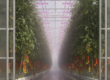
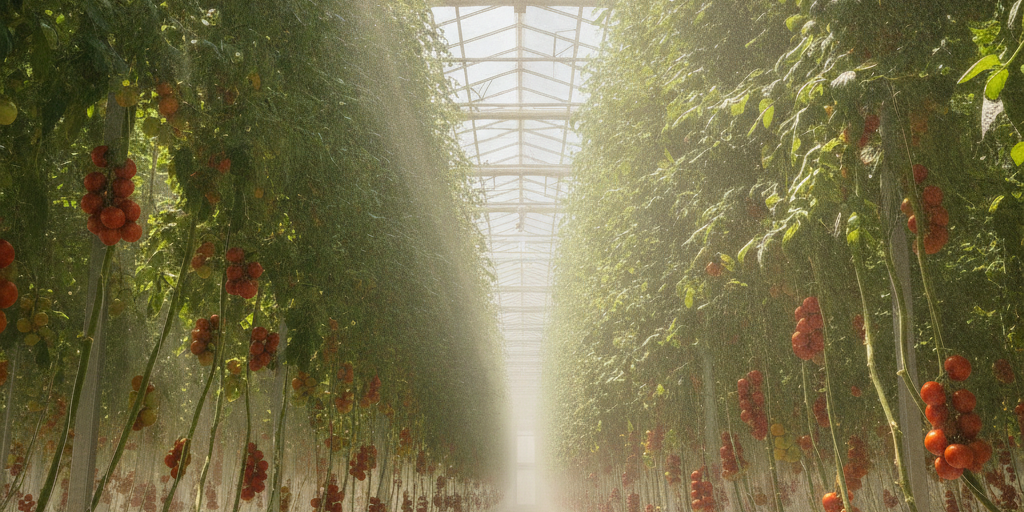
The key feature of this system is that the created water droplets evaporate while suspended in the air without falling onto plants or soil (‘flash evaporation’). This increases ambient humidity without creating undesirable wetness on leaves. This is the fundamental difference that distinguishes it from low-pressure ‘misting’ systems. While misting systems wet plants, fog humidification systems humidify the air.
Main Components of the System:
- High-Pressure Pump: The heart of the system, delivering water at the required pressure.
- Filtration and Water Conditioning: Purification of minerals and particles in the water (usually with Reverse Osmosis – RO) is critical to prevent nozzle clogging.
- Stainless Steel Piping: High-pressure resistant and long-lasting piping.
- Special Anti-drip Nozzles: Precisely engineered sprayers that do not drip water when the system is off.
- Automation Control Panel: Works integrated with the climate computer to automatically manage the system based on data from humidity sensors.
Synergy: Integration of Greenhouse Heating Systems and Fog Technology
Many growers consider heating and humidification as two separate issues. However, these two systems are directly related and form a whole that affects each other’s efficiency. High-pressure fog is not just a humidification tool but also an important complement to the heating strategy.
1. Preventing Drying Caused by Heating
When greenhouse heating systems operate during winter months or cold nights, the air temperature inside the greenhouse increases. Heated air has a greater capacity to hold moisture, which causes relative humidity (RH) to drop rapidly. This leads to high VPD, creating a stressful environment for plants. The fog system instantly balances this drying effect, maintaining ideal humidity levels for plants even during heating.
2. Energy Efficiency and Savings
High-pressure fog systems draw heat from the environment during evaporation. This ‘evaporative cooling’ effect prevents the greenhouse from overheating, especially in hot climates or during seasonal transitions. This allows for less frequent opening of ventilation windows. Keeping windows more closed conserves energy spent on heating and retains carbon dioxide supplied by CO2 fertilization systems, which is vital for plants. Therefore, the fog system indirectly helps save on heating and CO2 costs.
3. Creating a Homogeneous Climate
A properly designed fog system ensures a homogeneous humidity distribution within the greenhouse. This prevents the formation of microclimate differences at various points in the greenhouse. A homogeneous climate promotes uniform plant growth and increases standard quality at harvest. The negative effects of hot and dry air currents created by heating pipes are minimized with the fog system.
Fog System Applications in Turkish Conditions: Field Notes
As Green Climate, a company based in Antalya and Aksaray, our experiences in different climate regions of Turkey clearly demonstrate the importance of fog systems.
- Mediterranean and Aegean Regions (Antalya, Izmir): In combating extreme heat during summer months, fog systems function as an effective greenhouse cooling system component. They can reduce temperatures by up to 5-8°C while protecting plants from stress. In winter, they maintain humidity balance during heating periods.
- Central Anatolia Region (Aksaray, Konya): The typical characteristic of this region is hot and dry summers, and cold and dry winters. Low natural humidity levels make fog systems indispensable year-round. Controlling VPD during the intensive heating months of winter is a necessity for efficiency.
The most important practical detail to remember is water quality. Since water in Turkey is generally hard, a reverse osmosis (RO) water purification system must be installed before high-pressure fog systems. Otherwise, nozzles will clog quickly, and the system will become inefficient.
Conclusion: Thinking Integrally Means Maximum Efficiency
In conclusion, high-pressure fog technology is not a luxury addition but a fundamental climate control tool in modern greenhouse cultivation. Especially when considered in an integrated manner with greenhouse heating systems, it offers a wide range of benefits, from protecting plant health to increasing energy efficiency. As Green Climate, we do not just sell a product in our projects; instead, we design integrated climate control solutions that communicate with each other, tailored to your greenhouse’s geographical location, the crop you will grow, and your goals. With smart systems that manage all parameters such as heating, cooling, humidification, and CO2 from a single center, we help you maximize your greenhouse’s potential.
Frequently Asked Questions
What is the main difference between a high-pressure fog system and a low-pressure misting system?
The main difference lies in the size of the water droplets. High-pressure fog systems atomize water into droplets small enough to evaporate in the air (5-10 microns), humidifying the air without wetting the plants. Low-pressure misting systems, however, create larger droplets, which can lead to wetting of leaves and soil, increasing the risk of fungal diseases.
Will the fog system cause wetness on my plants?
No. A properly designed and calibrated high-pressure fog system operates on the principle of ‘flash evaporation,’ meaning water droplets evaporate in the air before reaching the plants. This ensures no wetness or dripping occurs on your plants or in your greenhouse.
How much water and electricity do fog systems consume?
Consumption varies depending on the size of the greenhouse, the number of nozzles, and operating time. However, generally, they are highly efficient systems compared to the evaporative cooling and humidification benefits they provide. Especially the heat savings achieved by reducing ventilation help balance energy costs.
How important is water quality for the system?
It is extremely important. Since the orifices of high-pressure nozzles are at a micron level, limescale and other minerals in the water can easily cause clogging. Therefore, for the system to operate efficiently and have a long lifespan, it must be used in conjunction with an effective water purification system such as reverse osmosis (RO).
For your greenhouse climate control project, get a free survey and quote from Green Climate’s expert team: Contact us.