For any high-yield greenhouse in the United Arab Emirates, effective cooling is not an option; it’s a necessity. Evaporative cooling methods, such as pad-and-fan or fogging systems, are common choices. However, their performance is governed by a fundamental law of physics tied to the local climate: the wet-bulb temperature. Understanding this single parameter is the key to realistic expectations and successful system design for your greenhouse cooling project.
The wet-bulb temperature represents the lowest temperature that can be reached through the evaporation of water alone. It is the absolute limit for any evaporative cooling system. No matter how powerful your fans or how high the pressure of your fogging system, the air temperature inside your greenhouse cannot drop below the outdoor wet-bulb temperature.
The Greenhouse Cooling Challenge in the UAE
Operating a greenhouse in the UAE presents a unique set of environmental challenges. The combination of high ambient temperatures and intense solar radiation can quickly create conditions lethal to most commercial crops. Without active cooling, the internal temperature of a greenhouse can soar 15-20°C or more above the outside air temperature, making cultivation impossible for much of the year.
The goal of a cooling system is to manage this heat load and maintain an optimal growing environment. To design an effective system, we must first understand the specific climatic conditions of the project site, which requires moving beyond simple temperature readings.
Understanding Key Climate Terms for Cooling Design
To properly evaluate cooling performance, it’s essential to be familiar with a few terms from psychrometrics, the science of moist air properties. These are not just academic concepts; they are the practical tools for engineering effective climate control.
Dry-Bulb Temperature (Tdb)
This is the standard air temperature measured by a regular thermometer, shielded from direct sunlight and moisture. It’s the temperature value typically reported in weather forecasts. While important, it only tells part of the story.
Wet-Bulb Temperature (Twb)
Imagine a thermometer with its bulb covered in a wet cloth. As water evaporates from the cloth, it cools the bulb. The final temperature it reaches is the wet-bulb temperature. This value is always less than or equal to the dry-bulb temperature. The difference between the two is a direct measure of the air’s capacity to absorb more water vapor—in other words, its potential for evaporative cooling.
Wet-Bulb Depression
This is the simple difference between the dry-bulb and wet-bulb temperatures (Tdb – Twb). A large wet-bulb depression indicates dry air with a high potential for evaporative cooling. A small depression signifies humid air where very little additional evaporation can occur, severely limiting the cooling effect.
Coastal vs. Inland UAE: A Tale of Two Climates
The UAE’s geography creates distinctly different climate zones that have a massive impact on greenhouse cooling design. Treating a project in Dubai the same as one in Al Ain is a common and costly mistake. The primary difference lies in humidity, which directly affects the wet-bulb temperature.
Coastal Regions (e.g., Dubai, Abu Dhabi, Sharjah)
These areas experience high humidity, especially during the summer months. The air is already laden with moisture from the Arabian Gulf.
- Climate Profile: High dry-bulb temperature and high relative humidity.
- Resulting Condition: The wet-bulb temperature is close to the dry-bulb temperature, leading to a small wet-bulb depression.
- Cooling Implication: The potential for evaporative cooling is significantly limited. Systems will still provide some cooling, but the temperature drop will be modest.
Inland Regions (e.g., Al Ain)
Inland desert locations have a more arid climate. While daytime dry-bulb temperatures can be even higher than on the coast, the air contains far less moisture.
- Climate Profile: Very high dry-bulb temperature and low relative humidity.
- Resulting Condition: The wet-bulb temperature is much lower than the dry-bulb temperature, resulting in a large wet-bulb depression.
- Cooling Implication: There is a very high potential for evaporative cooling. Pad-and-fan or fogging systems can achieve a substantial temperature reduction.
How Evaporative Cooling Systems Are Limited by Twb
Both primary types of evaporative greenhouse cooling systems rely on the same principle: converting water from liquid to vapor absorbs heat energy from the air. However, their performance is capped by the wet-bulb temperature.
Pad and Fan Systems
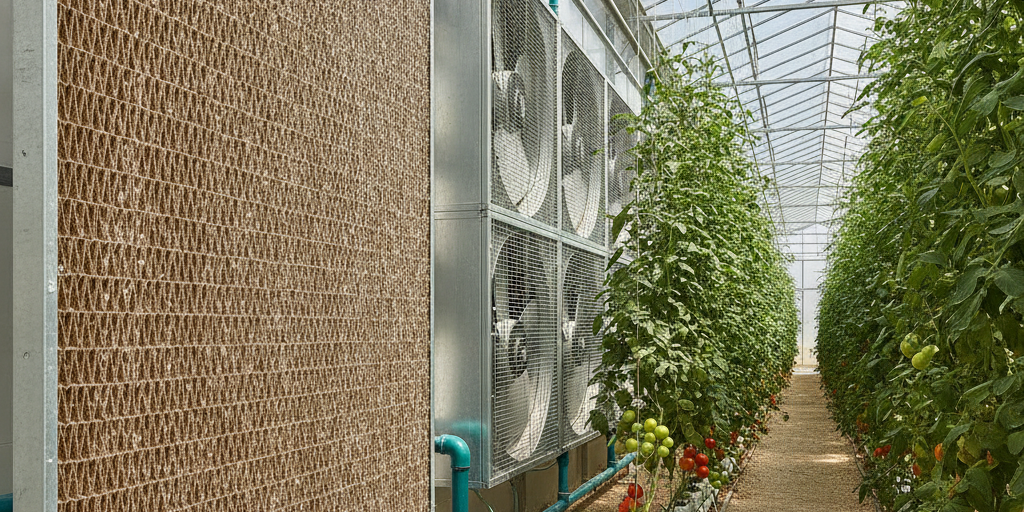
In these systems, exhaust fans at one end of the greenhouse pull air through wet pads installed at the opposite end. As the hot, dry outside air passes through the saturated pads, water evaporates, and the air is cooled before entering the growing area. The system’s effectiveness is measured by its evaporative efficiency, typically between 75-85% for a well-maintained system.
High-Pressure Fogging Systems
These systems use high-pressure pumps to atomize water into billions of tiny droplets (typically 5-15 microns) that are released into the greenhouse air. This fine mist evaporates almost instantly—a process called flash evaporation—cooling the surrounding air. The key is that the droplets must evaporate before they land on plant surfaces or equipment. Properly designed high-pressure greenhouse fogging systems can achieve very high evaporative efficiencies.
Calculating Real-World Cooling Potential
The theoretical lowest temperature is the wet-bulb temperature, but in practice, no system is 100% efficient. We can estimate the actual outlet air temperature from a cooling system using a simple formula:
Outlet Temp = Inlet Tdb – (Efficiency % × (Inlet Tdb – Inlet Twb))
Where:
- Inlet Tdb: The outdoor dry-bulb temperature.
- Inlet Twb: The outdoor wet-bulb temperature.
- Efficiency %: The rated efficiency of your pad or fogging system (e.g., 0.80 for 80%).
This formula clearly shows that the maximum possible temperature drop (Tdb – Twb) is determined entirely by the outside climate. The system’s efficiency only determines how much of that potential you can achieve.
Illustrative UAE Design Scenario (Hypothetical)
Let’s compare the performance of an identical cooling system (assumed 80% efficiency) in two different UAE locations on a hot August afternoon. Important: These are illustrative values for demonstration only. An actual design requires certified meteorological data for the specific project site.
Scenario 1: Coastal Location (near Dubai)
- Outdoor Conditions: Dry-Bulb (Tdb) = 42°C, Relative Humidity = 50%
- Resulting Climate: Wet-Bulb (Twb) ≈ 32°C
- Wet-Bulb Depression: 42°C – 32°C = 10°C
- Calculated Outlet Temperature: 42°C – (0.80 × 10°C) = 34°C
Scenario 2: Inland Location (near Al Ain)
- Outdoor Conditions: Dry-Bulb (Tdb) = 45°C, Relative Humidity = 20%
- Resulting Climate: Wet-Bulb (Twb) ≈ 26°C
- Wet-Bulb Depression: 45°C – 26°C = 19°C
- Calculated Outlet Temperature: 45°C – (0.80 × 19°C) = 29.8°C
The result is clear: despite the inland location being 3°C hotter (dry-bulb), the cooling system can achieve an indoor temperature that is over 4°C cooler. This is purely due to the lower humidity and the resulting lower wet-bulb temperature.
Beyond Temperature: Water, Energy, and Maintenance
Choosing a cooling system involves more than just temperature calculations. The high evaporation rates required in the UAE have significant operational consequences.
- Water Consumption: Evaporative cooling systems use large volumes of water. This is a critical operating cost and a factor in resource planning.
- Water Quality: As water evaporates, dissolved minerals like calcium and magnesium are left behind. This scale can clog cooling pads and fog nozzles, drastically reducing efficiency and requiring intensive cleaning or replacement. A professional water analysis is mandatory before system selection to plan for necessary filtration or treatment.
- Energy Consumption: Large exhaust fans and high-pressure pumps are significant electricity consumers. The system must be sized correctly to provide adequate cooling without excessive energy costs.
Checklist for Your UAE Greenhouse Cooling Project
A successful cooling system starts with a thorough engineering brief. Before requesting a quotation, be prepared to provide the following essential information. This ensures the design is based on your specific conditions, not generic assumptions.
- Project Location: The specific emirate and site coordinates are needed to source accurate climate data.
- Greenhouse Specifications: Provide the length, width, gutter height, and covering material (e.g., polycarbonate, glass, plastic film).
- Crop Requirements: State the target temperature and humidity range for the specific crop you intend to grow.
- Climate Design Data: If available, provide the design dry-bulb and corresponding wet-bulb temperatures for your location. If not, this must be determined.
- Water Analysis Report: A recent laboratory analysis of your water source is crucial for equipment selection and longevity.
- Available Utilities: Specify the available electrical supply (voltage, phase, capacity) and water flow rate.
By understanding the fundamental role of wet-bulb temperature, you can engage with engineering partners more effectively, set realistic performance goals, and make informed investment decisions. The right cooling system is one that is engineered for your specific location, crop, and operational reality.
To discuss the specific cooling requirements for your project in the UAE, our engineering team can provide a preliminary assessment. Request a preliminary UAE greenhouse cooling assessment by sending the project location, greenhouse dimensions, crop, water analysis, electrical information, drawings, and site photographs.
Frequently asked questions
What exactly is wet-bulb temperature?
Wet-bulb temperature is the lowest temperature to which air can be cooled by the evaporation of water at a constant pressure. It is measured with a thermometer whose bulb is covered in a water-moistened wick and represents the physical limit for evaporative cooling technologies.
Can evaporative cooling work in humid coastal areas like Dubai?
Yes, it can provide a temperature reduction, but its effectiveness is limited compared to drier inland areas. During periods of very high humidity, the cooling effect will be minimal because the air is already near its saturation point, and little evaporation can occur.
Why is a water analysis so important for a cooling system?
As water evaporates, it leaves behind dissolved minerals which form scale. This scale can clog cooling pads and fog nozzles, severely reducing system efficiency and potentially damaging equipment. A water analysis allows for proper filtration and treatment to be included in the design, protecting your investment.
How do I find the design wet-bulb temperature for my location?
This requires historical meteorological data from the nearest official weather station. Engineering firms and climate consultants use specialized software to analyze this data and determine the appropriate design conditions (e.g., the values not exceeded for 99% of hours) for reliable system performance.
Discuss your greenhouse climate project with Green Climate: Contact our team.