Successfully implementing cucumber greenhouse cooling in the UAE requires an integrated approach that treats temperature, humidity, air movement, and crop transpiration as a single, interconnected system. Simply installing equipment is not enough; the solution must be engineered for your specific location, greenhouse structure, and production goals to maintain the delicate balance cucumbers need to thrive in an extreme climate.
This guide compares the primary cooling technologies and outlines the critical engineering data required for a successful project. Understanding these factors is the first step toward achieving optimal growth conditions and maximizing your yield. The right choice depends on a careful evaluation of your local climate and operational resources, which is a core part of designing effective greenhouse cooling systems.
The Unique Challenge of Cucumber Cooling in the UAE
Cucumbers are sensitive to both heat stress and high humidity. In the UAE’s climate, the primary challenge is removing a massive heat load while managing the high levels of moisture released by the plants themselves through a process called transpiration. A dense cucumber crop can release significant amounts of water vapor, quickly raising the greenhouse humidity.
When humidity is too high, the plant’s ability to transpire slows down. This reduces nutrient uptake and makes the crop vulnerable to fungal diseases like downy mildew. The goal is not just to cool the air, but to create an active climate that encourages transpiration at a healthy rate without causing plant stress.
Coastal vs. Inland Climates: Why Location Matters
The UAE’s climate is not uniform, and a cooling system that works in one area may be inefficient in another. A key distinction must be made between coastal and inland locations, as this directly impacts the effectiveness of evaporative cooling methods.
- Coastal Areas (e.g., Dubai, Abu Dhabi, Sharjah): These regions experience very high ambient humidity, especially during the summer months. The air is already laden with moisture, which severely limits the potential of purely evaporative cooling. The wet-bulb temperature is high, providing a smaller margin for temperature reduction.
- Inland Areas (e.g., Al Ain): These desert locations are characterized by higher temperatures but significantly lower ambient humidity. The large difference between the dry-bulb and wet-bulb temperatures makes evaporative cooling much more effective, allowing for a greater potential temperature drop.
Comparing Cooling Systems for UAE Cucumber Greenhouses
Choosing the right technology requires a clear understanding of how each system interacts with your local climate and the specific needs of your cucumber crop. The two most common methods are pad-and-fan and high-pressure fogging.
Pad-and-Fan Evaporative Cooling
This system works by pulling hot, dry outside air through wet cellulose pads. As the water evaporates, it cools the air, which is then drawn across the greenhouse by exhaust fans at the opposite end. This creates a temperature gradient, with the area near the pads being coolest.
Its suitability is highly dependent on the external climate. In the low humidity of Al Ain, it can be an effective and energy-efficient solution. However, in the high humidity of Dubai, its cooling capacity is drastically reduced, and it can contribute to overly saturated conditions inside the greenhouse.
High-Pressure Fogging Systems
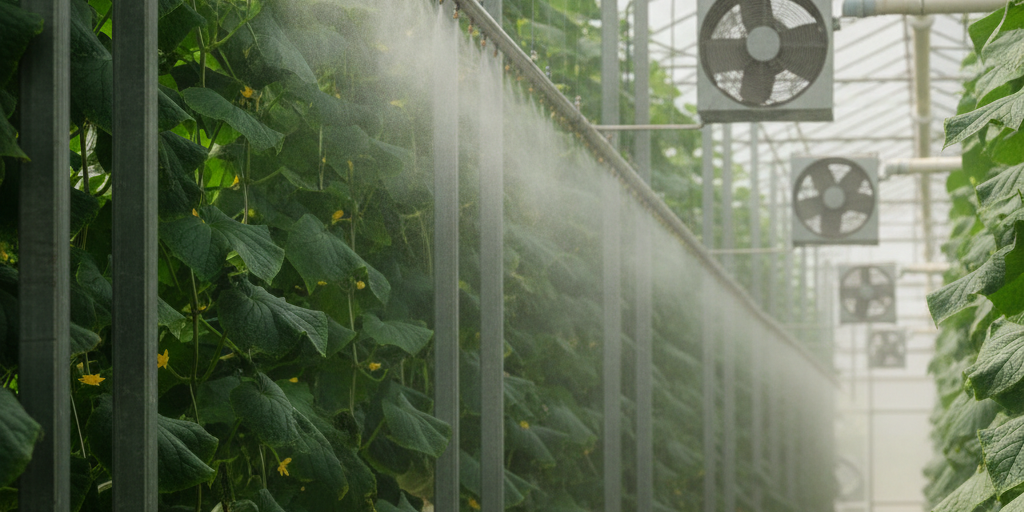
High-pressure fogging uses pumps to pressurize water to 70 bar or higher, atomizing it into micro-droplets through specialized nozzles. These droplets are so small they evaporate almost instantly in the air—a process called flash evaporation. This cools the air without wetting the plants’ leaves when designed and operated correctly.
Because fog systems can be controlled with precision and used within a closed or semi-closed greenhouse, they are often more suitable for the UAE’s humid coastal regions. They provide more uniform cooling and can be used to maintain specific humidity levels, making them a versatile tool for climate management. These are advanced solutions, and you can learn more about high-pressure greenhouse fogging systems to see how they operate.
Key Engineering Inputs for System Design
A reliable cooling system cannot be selected based on greenhouse area alone. A thorough engineering assessment requires specific data to calculate the total heat load and design an effective solution.
- Location Data: This includes historical outdoor design conditions, specifically the maximum dry-bulb and corresponding wet-bulb temperatures for your exact project site.
- Greenhouse Specifications: Dimensions (length, width, height), covering material (which affects solar gain), and the presence of thermal screens or shading are all critical.
- Ventilation Capacity: The size, type, and position of existing roof and side vents determine the natural air exchange rate, which must be factored into the cooling load.
- Crop Parameters: The type of crop (cucumber), planting density, and growth stage directly influence the transpiration rate and the amount of water vapor released into the greenhouse.
Managing Humidity and Air Movement
Cooling is only one part of the equation. Proper air movement is essential to distribute cool air, prevent stagnant microclimates around the plants, and help manage humidity. Horizontal air flow (HAF) fans are often used to create a gentle, circular air pattern within the greenhouse.
Effective humidity control involves carefully balancing ventilation, cooling, and air circulation. In the early morning, as the sun rises and temperatures increase, humidity can spike. A control system should be programmed to activate ventilation or heating slightly to manage this transition and prevent condensation on the leaves. This is particularly important in large-scale hydroponic greenhouse systems where precise climate control is paramount.
Water, Energy, and Maintenance Considerations
Your choice of cooling system has long-term operational implications. Pad-and-fan systems generally have lower initial costs but can consume large volumes of water and require regular pad cleaning or replacement to prevent algae and mineral buildup.
High-pressure fogging systems require a higher initial investment due to the specialized pumps and filtration. However, they typically use less water than pads. Water quality is non-negotiable for fog systems; reverse osmosis (RO) or other water treatment is almost always required to prevent nozzle clogging. Energy consumption depends on the pump’s operating hours, which are managed by the climate controller.
Önemli: Before specifying any evaporative cooling equipment, a comprehensive water analysis is essential. High levels of salts, calcium, or other minerals can quickly damage pads and clog fog nozzles, leading to system failure.
Checklist for Your UAE Greenhouse Cooling Project
Before requesting a proposal, gather the following information to facilitate an accurate engineering assessment:
- Project Location: Specify the emirate and nearest city (e.g., Al Ain, Abu Dhabi).
- Greenhouse Details: Provide dimensions (width, length, gutter height) and covering material.
- Crop Information: Confirm the crop is cucumber and note the planned production period.
- Infrastructure Data: Have a recent water analysis report and details of the available electrical supply capacity.
- Site Plans: If available, provide drawings and photographs of the greenhouse and site.
A detailed assessment based on this data is the only way to ensure your cooling system will perform as expected. This approach moves beyond guesswork and toward an engineered solution tailored to the demanding climate of the UAE.
Frequently asked questions
What is the ideal humidity range for cucumbers in a UAE greenhouse?
Cucumbers generally prefer a relative humidity of 60-70%. In the UAE, the main challenge is often keeping humidity from rising too high, which can slow nutrient uptake and encourage disease. An active climate strategy using controlled ventilation and cooling is essential.
Can I use pad-and-fan cooling in high-humidity coastal areas like Dubai?
Using pad-and-fan systems in coastal UAE is challenging because the high ambient humidity limits their cooling potential. While they might provide a small temperature drop, they can also add too much moisture to the greenhouse. High-pressure fogging or hybrid systems are often more effective in these locations.
How does high plant density affect my cooling and humidity strategy?
Higher cucumber plant density means a greater leaf surface area, which leads to a much higher rate of transpiration. This adds a significant moisture load to the greenhouse air, increasing the demand on both your cooling and dehumidification systems. Your system must be sized to handle this peak load.
Is a fogging system more water-efficient than pad-and-fan?
Generally, high-pressure fogging systems use less water than pad-and-fan systems to achieve a similar cooling effect because the water is atomized and evaporates more efficiently. However, fog systems often require pre-treatment like reverse osmosis, so total water usage should account for the RO system's reject water.
Discuss your greenhouse climate project with Green Climate: Contact our team.