Efficiency in the Desert: Why Greenhouse Cooling is Critical in the UAE
Cultivating crops in hot and arid desert climates like the United Arab Emirates (UAE) is a challenge that pushes the boundaries of technology and engineering. In this region, where ambient temperatures can exceed 50°C, the heart of a high-tech greenhouse is undoubtedly its climate control system. This is where the greenhouse cooling commissioning UAE process stands out as the most critical stage, directly determining the project’s return on investment and sustainability.
At Green Climate, we adapt our Mediterranean climate experience to the extreme conditions of the UAE, developing unique solutions. The challenge here is not just high temperatures; it’s also managing factors like intense solar radiation, water quality, and sandstorms. Successful commissioning is possible only with a holistic approach that accounts for each of these elements.
Anatomy of the Commissioning Process: Green Climate’s Engineering Approach
Commissioning is not merely ‘starting and leaving’ a system; it is the process of scientifically verifying and optimizing that the project has met its design values. This process safeguards your investment and maximizes operational efficiency. The steps we follow in our UAE projects ensure we achieve predictable results even under the most challenging conditions.
We divide the process into a series of meticulously planned phases:
- Phase 1: Pre-Inspection and Design Verification: Before stepping onto the site, all engineering drawings, equipment specifications, and automation scenarios are thoroughly reviewed. This phase ensures that the project’s promises on paper align with physical reality and allows us to identify potential issues early.
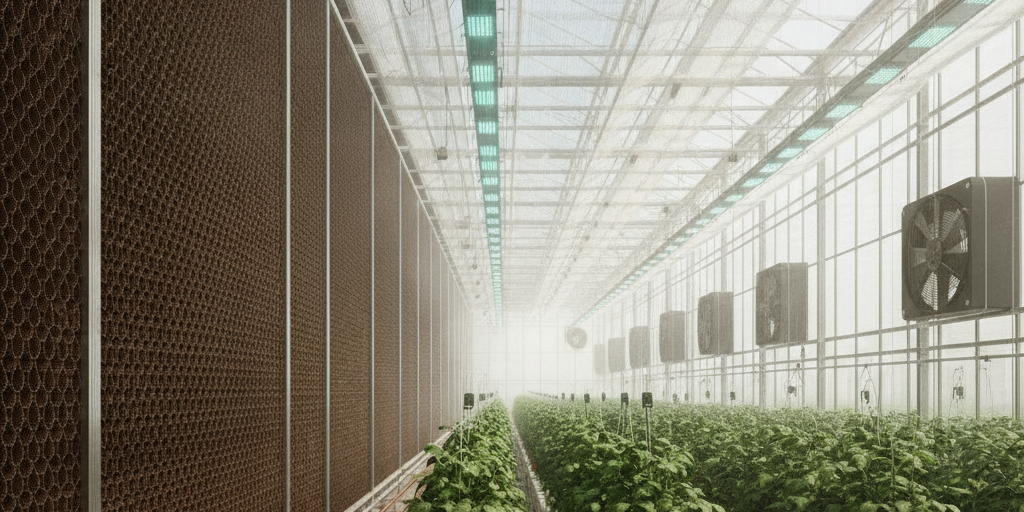
- Phase 2: Mechanical and Electrical Installation Supervision: Our teams inspect all components of the installed system. Details such as fan angles, the homogeneity of pad wetting, pump alignment, and the safety of electrical panels are vital for system performance.
- Phase 3: Initial System Start-up and Hydraulic Balancing: Water is introduced to the cooling system during this phase. For pad-fan systems, even distribution of water across the entire pad surface, measurement of pressure losses, and adjustment of pump flow rates are fundamental for energy efficiency and cooling capacity.
- Phase 4: Performance Tests and Data Logging: This is the most scientific step of commissioning. Temperature, humidity, and air velocity data are collected from various points within the greenhouse via sensors. Critical performance indicators (KPIs) such as whether the system achieves the targeted temperature drop (delta T) at full load, and hourly water and energy consumption, are recorded. This data forms our roadmap for optimization.
- Phase 5: Automation and Control System Integration: In modern greenhouses, cooling is managed by a climate computer. In this phase, sensors are calibrated, alarm limits are set, and scenarios are programmed to ensure the cooling system works in harmony with other hydroponic greenhouse systems elements such as lighting, fogging, and ventilation.
- Phase 6: Client Training and Facility Handover: We transfer all the intricacies of the system, daily operation, and basic maintenance routines to the client’s technical team. A successful project means not only a well-installed system but also a competent team capable of operating it correctly.
Key Performance Indicators (KPIs) Defining Success in UAE Conditions
The success of a greenhouse cooling commissioning UAE project is not an abstract concept; it is based on measurable data. The primary KPIs we focus on during the commissioning process are:
- Temperature Difference (Delta T): Indicates how much the system can reduce the temperature between the ambient outdoor environment and the greenhouse interior. Achieving targeted Delta T values in UAE conditions is critical for plant health.
- Relative Humidity Stability: Preventing excessive increases or decreases in humidity during cooling is essential for preventing plant stress and diseases. This balance is vital, especially in evaporative cooling systems.
- Energy Efficiency Ratio (EER): Measures how much cooling capacity (kW) is obtained per kilowatt-hour (kWh) of energy consumed. This is an efficiency metric that directly impacts the system’s operational cost.
- Water Consumption Rate: In a region where water is scarce, ensuring that the amount of water evaporated for cooling remains within design values is important for the project’s sustainability.
Field Experience: Common Commissioning Errors and Solutions
Years of Green Climate projects have taught us that theory does not always perfectly match practice. Especially in a challenging market like the UAE, there are common errors encountered during commissioning, and we have engineering solutions for them.
Error 1: Insufficient Air Tightness
Even small gaps in the greenhouse structure or leaks around door edges can severely reduce cooling performance. This causes the system to continuously draw in hot air from outside.Our Solution: As part of commissioning, we conduct negative pressure tests (smoke tests) to identify all air leakage points in the greenhouse and ensure they are sealed. This simple step can reduce energy costs by 10-15%.
Error 2: Incorrect Water Quality Management
Water in the UAE often has high salinity. If this water is used directly in the pads, it quickly leads to limescale and salt buildup, clogging the pad pores and reducing cooling efficiency.Our Solution: We ensure the installation of an appropriate water treatment (reverse osmosis, etc.) or conditioning system based on water analysis results. Additionally, we program automatic flushing (blowdown) periods into the automation system to extend the life of the pads. Effective greenhouse cooling systems begin with water management.
Error 3: Incorrect Sensor Placement
If temperature and humidity sensors feeding the climate control computer are placed in a location that does not accurately represent the plants’ living area, the entire system will make incorrect decisions. For example, a sensor placed in direct sunlight or too close to a fan will produce misleading data.Our Solution: We position sensors at plant height, protected from direct sunlight and air currents, within special radiation-shielded enclosures. This is a fundamental rule for precise climate control.
Conclusion: Secure Your Investment with an Engineering-Focused Commissioning
Establishing a successful agricultural operation in the desert heat of the UAE begins with selecting the right technology, but it truly comes to life through the correct commissioning process. Greenhouse cooling commissioning UAE is the critical bridge that transforms a project’s potential on paper into real and sustainable efficiency. This process is not merely a technical checklist, but also an engineering philosophy.
At Green Climate, we optimize every screw, every sensor, and every line of automation code to ensure your investment delivers the highest performance. Contact us to fully unlock your project’s potential and achieve maximum efficiency even in challenging climatic conditions. Our expert team will be happy to assist you in requesting a greenhouse cooling assessment for your project.
Important: Even after the commissioning process is complete, periodic monitoring of system performance and fine-tuning according to the season are strongly recommended for long-term success.
Frequently Asked Questions
How long does it take to commission a greenhouse cooling system in the UAE?
The duration varies depending on the size of the greenhouse and the complexity of the system. Generally, the entire process, from mechanical checks to performance tests and client training, can be completed within 7 to 15 days for a 1 to 3-hectare facility.
What is the biggest challenge encountered during commissioning?
The biggest challenge is often managing the discrepancy between theoretical design values and real-world conditions on site. Factors such as unexpected air leaks, water quality issues, or fluctuations in electrical infrastructure may require immediate engineering solutions.
Do you re-commission existing and inefficient greenhouse cooling systems?
Yes, we call this service ‘retro-commissioning’. We analyze your existing system, identify sources of inefficiency, make necessary improvements, and recalibrate the system for optimal performance to help you reduce energy and water costs.
Are the commissioning processes for pad-fan systems and high-pressure fogging systems different?
Yes, although the basic principles are similar, the details differ. For high-pressure fog systems, additional and more sensitive steps come into play, such as nozzle pressure adjustments, droplet size control, and ultrafiltration of water. We have expertise in both systems.
For your greenhouse climate control project, get a free survey and quote from Green Climate’s expert team: Contact us.