Challenges of Hydroponic Lettuce Cultivation in the UAE Climate
When modern agriculture in the United Arab Emirates (UAE) is mentioned, one of the first things that comes to mind is hydroponic production in controlled environments. However, the region’s extreme temperatures and high solar radiation pose significant challenges, especially for delicate leafy greens like lettuce. A successful hydroponic lettuce greenhouse cooling UAE operation requires much more than simply lowering the temperature; it demands an integrated climate management approach that understands plant biology.
Lettuce performs best under cool climate conditions. High temperatures directly affect the plant’s metabolism, negatively impacting both yield and quality. Therefore, for an investment in the UAE to be profitable, the cooling system must be precise and efficient, which is critically important.
Effects of High Temperature on Hydroponic Lettuce
Heat stress leads to a series of physiological deteriorations in lettuce plants. Understanding these issues is the first step in determining the correct cooling strategy. The most common problems include:
- Bolting: Under heat stress, the plant prematurely transitions to the generative phase, beginning to form seeds. This causes the leaves to become bitter and completely lose their market value.
- Tipburn: Necrotic spots observed on leaf tips due to impaired calcium transport. High temperature and low transpiration are the main factors triggering this physiological disorder.
- Root Zone Stress: In hydroponic systems, water temperatures exceeding 24°C make it difficult for roots to absorb oxygen. This creates a breeding ground for root rot and the spread of pathogens.
- Quality Losses: High temperatures loosen the texture of lettuce leaves, reduce their crispness, and shorten their shelf life. The flavor profile is also negatively affected by this condition.
Greenhouse Cooling Strategies Specific to UAE Conditions
The UAE has unique climatic characteristics, including not only high temperatures but also high humidity and intense solar radiation. Therefore, greenhouse cooling UAE solutions must be multifaceted. At Green Climate, drawing on our field experience, we design integrated systems that combine the most effective methods.
1. Evaporative Cooling: Fan-Pad Systems
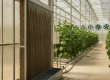
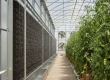
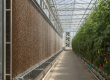
Fan-pad systems are one of the most basic greenhouse cooling methods. They operate on the principle of air passing through wet pads, being cooled by evaporation, and then drawn into the greenhouse. This system is an effective solution, especially in low-humidity environments such as the inland areas of the UAE.
However, in high-humidity coastal regions, the efficiency of evaporative cooling significantly decreases. In such cases, fan-pad systems alone will not be sufficient and will need to be supplemented with other technologies. With proper engineering calculations, the system’s capacity should be determined based on the greenhouse volume and the targeted temperature reduction.
2. High-Pressure Fogging
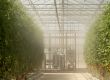
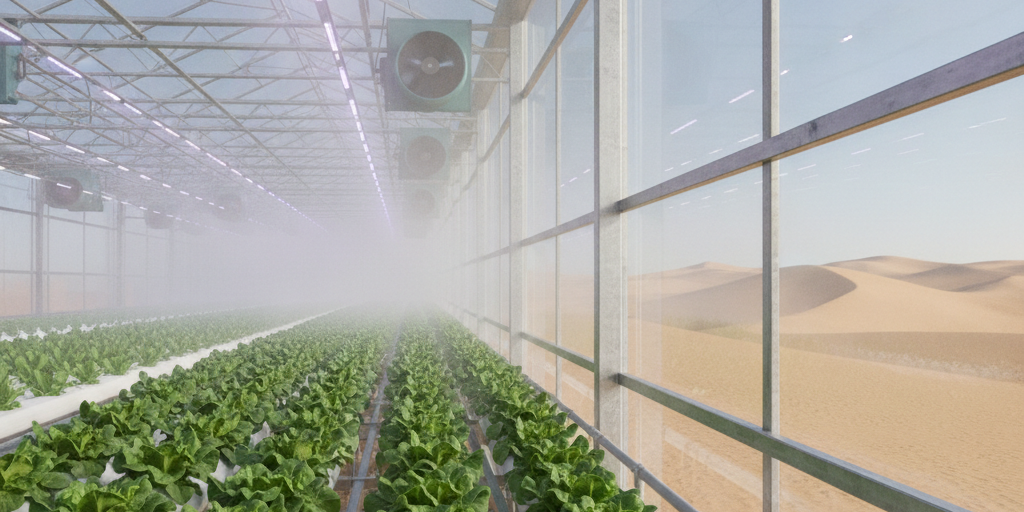
High-pressure fogging systems atomize water into very small micron-sized droplets, allowing them to remain suspended in the air. These water droplets absorb heat from the environment and instantly evaporate (flash evaporation), cooling the air. This method offers several advantages for hydroponic lettuce greenhouse cooling UAE.
- Humidity Control: Fogging not only provides cooling but also precisely controls the humidity level within the greenhouse. This is critical for regulating lettuce transpiration and preventing tipburn.
- Homogeneous Cooling: With correctly positioned nozzles, a more uniform temperature distribution is achieved within the greenhouse. This prevents developmental differences among plants.
- Low Water Consumption: Compared to fan-pad systems, they generally consume less water, which is a significant advantage in regions where water is precious, such as the UAE.
3. Root Zone Cooling
One of the most sensitive parts of lettuce is its roots. In soilless cultivation, controlling the nutrient solution temperature is vital for plant health. Root zone cooling aims to maintain the nutrient solution within the ideal temperature range (typically 18-22°C) by passing it through a chiller unit.
This method ensures that roots remain healthy and continue nutrient uptake even when ambient temperatures are high. It is particularly effective when applied in water-circulation-based hydroponic systems such as NFT (Nutrient Film Technique) or DFT (Deep Flow Technique).
4. Full Climate Control with Chillers and Air Handling Units (AHU)
For projects aiming for the highest precision and complete independence from external conditions, chillers and Air Handling Units (AHUs) are used. These closed-loop systems cool, dehumidify, and recondition the air within the greenhouse without being affected by external humidity or temperature. This represents one of the most advanced greenhouse cooling systems.
Important: The initial investment and operating costs of these systems are higher than others. However, for lettuce cultivation targeting premium markets that aim for uninterrupted, highest-quality production year-round, this is the most reliable solution.
Why is an Integrated System Design Important?
A successful lettuce greenhouse in the UAE does not rely on a single cooling technology. It requires an integrated approach where different systems work in harmony. At Green Climate, our project process includes the following steps:
- Analysis and Modeling: The climate data, water quality, greenhouse structure, and targeted production capacity of the project location are analyzed in detail. Thermal modeling is used to calculate the greenhouse’s heat loads.
- Technology Selection: Based on the analysis results, the most efficient and economical combination of cooling technologies is determined. For example, fan-pad systems can be used for basic cooling, fogging for precise control, and root zone cooling for critical root health, all in combination.
- Integration with Supporting Systems: The cooling system is integrated with shading screens, air circulation fans, and automation systems. Specifically, the heat generated by greenhouse lighting systems must also be included in the cooling load calculation.
- Automation and Control: All systems are managed by a central automation system that processes real-time data from sensors (temperature, humidity, light, CO2) and operates equipment optimally. This ensures energy efficiency and a stable climate.
Conclusion: A Scientific Approach is Essential for Lettuce Cultivation in the UAE
In conclusion, success in the hydroponic lettuce greenhouse cooling UAE market is not just about installing powerful cooling equipment. It requires a holistic engineering vision that combines plant needs, the challenges of the local climate, and the advantages of different technologies. A correctly designed climate control system accelerates return on investment, reduces operating costs, and enables consistent, high-quality product year-round.
At Green Climate, we provide proven solutions for the challenging conditions in the UAE. With our experience in past Green Climate projects, we are ready to work with you to develop the most suitable and efficient climate control strategy for your investment. To assess your project’s potential, you can contact us to request a greenhouse cooling feasibility study.
Frequently Asked Questions
What are the ideal greenhouse temperature and humidity for hydroponic lettuce?
Generally, hydroponic lettuce prefers a temperature range of 20-24°C during the day and 15-18°C at night. Relative humidity should be maintained between 60-75% to prevent diseases and support healthy transpiration.
What is the best cooling method for the high-humidity coastal regions of the UAE?
High external humidity reduces the efficiency of evaporative cooling (fan-pad) systems. For these regions, high-pressure fogging and especially closed-loop chiller-supported air handling units (AHU) offer more reliable and effective cooling solutions.
Is root zone cooling really necessary?
Yes, it is critically important, especially in hot climates like the UAE. Even if you cool the ambient air, the water in nutrient solution tanks and pipes can easily heat up. Water temperatures exceeding 24°C lead to oxygen deficiency in the roots and diseases, so root zone cooling is an insurance for quality and yield.
How can I reduce the energy cost of the cooling system?
To reduce energy costs, it is important for the greenhouse to be well-insulated, to use heat and light-controlled shading screens, to operate systems efficiently with automation, and, if possible, to utilize renewable energy sources such as geothermal or solar.
For your greenhouse climate control project, get a free survey and quote from Green Climate’s expert team: Contact us.