The Importance of Greenhouse Ventilation in Hot Climates
In modern greenhouse cultivation, precise climate control is fundamental to efficiency. Especially in Mediterranean and similar hot climate zones, overheating is one of the biggest challenges. At this point, a correctly designed ventilation system determines the fate of production, and greenhouse fan selection in hot climates forms the heart of this system.
A fan with incorrect capacity or type not only means insufficient cooling; it also increases energy costs, slows plant development, and raises the risk of disease. As Green Climate, we aim to illuminate every step of this critical process with our engineering expertise.
Fundamental Principle: What is the Air Change Rate (ACH)?
The starting point for greenhouse ventilation calculations is the ‘Air Change Rate,’ which expresses how often the air inside the greenhouse is completely replaced. This value is typically measured as ‘air changes per minute.’ Our goal is to effectively remove heat generated by solar radiation and plant transpiration from the greenhouse.
For hot climate conditions, the general engineering acceptance is that the air in the greenhouse should be completely changed 1 to 1.5 times per minute. This rate prevents the formation of hot air pockets inside, providing a more stable and healthy environment for plants.
Step-by-Step Required Airflow Calculation
Determining the total fan capacity requires a systematic approach. This process relies on the physical characteristics of your greenhouse, and careful measurement is essential for accurate results.
Step 1: Greenhouse Volume Calculation
First, you need to find the total area to be ventilated, which is the internal volume of your greenhouse in cubic meters (m³). The basic formula for this calculation is quite simple: Volume = Length x Width x Average Height.
Average height varies depending on the roof structure. For example, in a gable-roofed greenhouse, the average height can be found by taking the average of the sidewall height and the roof peak height. For gothic or rounded roofs, more detailed geometric formulas may be required for this calculation.
Step 2: Determining Total Airflow Rate
After calculating the greenhouse volume, you can find the total required airflow rate using your target air change rate. This value is usually expressed in cubic meters per hour (m³/hour).
The formula is: Total Airflow Rate (m³/hour) = Greenhouse Volume (m³) x Air Changes Per Minute x 60. For example, if a greenhouse with a volume of 3000 m³ targets 1 air change per minute, a total airflow rate of 3000 x 1 x 60 = 180,000 m³/hour is needed.
Static Pressure: The Hidden Enemy of Ventilation
One of the most critical factors overlooked by many growers is static pressure. Simply put, static pressure is the sum of resistances encountered by air as it moves through the greenhouse. Fans work to overcome this resistance, and as pressure increases, the air-moving capacity of the fans decreases.
Ignoring this resistance causes a fan that appears sufficient on paper to perform far below expectations in the field. This is the most common and costly mistake made when making greenhouse fan selection in hot climates.
What Factors Cause Static Pressure?
Various equipment and structures within the greenhouse create obstacles to airflow. The main obstacles are:
- Cooling Pads: Especially in pad-fan systems, wet pads create the greatest resistance to air passage.
- Insect Screens: These screens, essential for plant health, significantly increase static pressure depending on their mesh structure.
- Louvers and Dampers: Louvers at the front of fans and air inlets are also sources of resistance.
- Plant Density: A mature and dense plant canopy, in particular, slows air movement and contributes to pressure.
- Internal Greenhouse Equipment: Hanging pipes, lighting fixtures, and other structures also disrupt airflow.
In a typical modern greenhouse, the total static pressure usually ranges between 25 and 60 Pascals (Pa). This value must be precisely calculated by our engineering team according to the equipment to be used.
How to Choose the Right Fan? Capacity, Efficiency, and Number
After determining the total required airflow rate and the static pressure the system will encounter, it’s time to select the right fans. This stage involves more than just comparing numbers.
Reading Fan Performance Curves
Every fan has a performance curve or table provided by the manufacturer. This graph shows how much air the fan can move at different static pressure levels. When making a selection, you should look at the fan’s airflow rate at the target static pressure you calculated, not its ‘free air delivery’ (at 0 Pa pressure) value.
How Many Fans Do You Need?
The total number of fans is found by a simple division: Number of Fans = Total Required Airflow Rate / Airflow Rate of a Single Fan at Target Pressure. For example, if you need 180,000 m³/hour and the fan model you choose moves 45,000 m³/hour at the target pressure, you will need 180,000 / 45,000 = 4 fans.
Using a larger number of smaller fans instead of a few large ones generally provides more homogeneous air distribution and greater security (redundancy) against system failures.
Energy Efficiency: Long-Term Gain
The operating cost of fans is as important as their initial investment cost. Fan efficiency is usually measured by ‘air moved per Watt’ (m³/hour/Watt). A highly efficient fan does the same job with lower energy consumption, which means significant savings on electricity bills over the years.
In the greenhouse cooling systems we design at Green Climate, we always prioritize the most energy-efficient equipment to reduce the investor’s operating costs.
Fan Placement Strategies for a Homogeneous Climate
Selecting the correct number and capacity of fans is only half of the equation. Where and how these fans are placed directly impacts the homogeneity of the climate within the greenhouse. The goal is to ensure balanced air movement throughout the entire greenhouse volume without creating dead zones or excessive air currents.
Tunnel Ventilation Principle
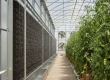
The most common and effective method is tunnel ventilation. In this system, fans are placed on one short wall of the greenhouse, and air inlets (usually cooling pads) are placed on the opposite wall. This allows air to move longitudinally through the greenhouse as if in a tunnel, carrying heat and humidity with it.
Critical Placement Rules
For effective tunnel ventilation, the following rules should be observed:
- Fan Spacing: Fans should be placed at equal intervals along the exhaust wall. As a general rule, there should be no more than 7-8 meters between fan centers.
- Height: Fans should generally be mounted on the upper part of the wall, near the roof, where the hottest air accumulates.
- Maximum Length: The effectiveness of tunnel ventilation decreases with distance. In greenhouses longer than 50-60 meters, it becomes difficult to ensure uniform air speed and temperature, and different strategies may be required.
- Avoid Obstacles: Large structures (offices, storage, etc.) that would obstruct airflow should not be placed immediately in front of or behind the fans.
Important: For very wide or compartmentalized greenhouses, Computational Fluid Dynamics (CFD) analyses may be required to ensure ideal airflow. For complex projects, requesting a greenhouse cooling assessment is the most appropriate approach.
Conclusion: An Engineering Approach Brings Success
As seen, greenhouse fan selection in hot climates is not a simple product choice, but an engineering process requiring careful calculations and field experience. Starting from volume calculation, determining the air change rate, predicting static pressure, and finally placing the right fan in the right place are integral parts of a whole.
Managing this process correctly allows you to create the ideal growing environment for your plants while keeping your energy costs under control. Green Climate’s completed Green Climate projects demonstrate the successful application of these engineering principles. Whether you are setting up new hydroponic greenhouse systems or looking to improve your existing system, our expert team is ready to offer you the most efficient solutions.
Frequently Asked Questions
What should be the ideal air speed inside the greenhouse?
The ideal air speed varies depending on the plant species and growth stage, but generally, a range of 0.5 to 1.5 meters per second (m/s) is targeted. This speed encourages transpiration by breaking up the humid and stagnant air layer around the plant, but should not be so strong as to harm young plants.
Can I use circulation fans (HAF) instead of exhaust fans for cooling?
No, these two fan types serve different purposes. Exhaust fans are designed to expel hot air from the greenhouse (air change). Circulation fans, on the other hand, move the air inside to ensure homogeneous distribution of temperature and humidity (air mixing). For effective climate control, both are usually used together.
Does altitude (height above sea level) affect fan performance?
Yes, it definitely does. Air density decreases at high altitudes. This causes the fan to move less air mass despite rotating at the same speed, meaning its performance decreases. This factor must be taken into account in fan calculations for high-altitude regions.
What is the biggest mistake growers make in fan selection?
The most common and costly mistake is to completely disregard or underestimate static pressure. Ignoring resistance sources such as insect screens and cooling pads and selecting fans based only on their catalog’s free air delivery results in great disappointment and insufficient cooling in the field.
For your greenhouse climate control project, get a free survey and quote from Green Climate’s expert team: Contact us.