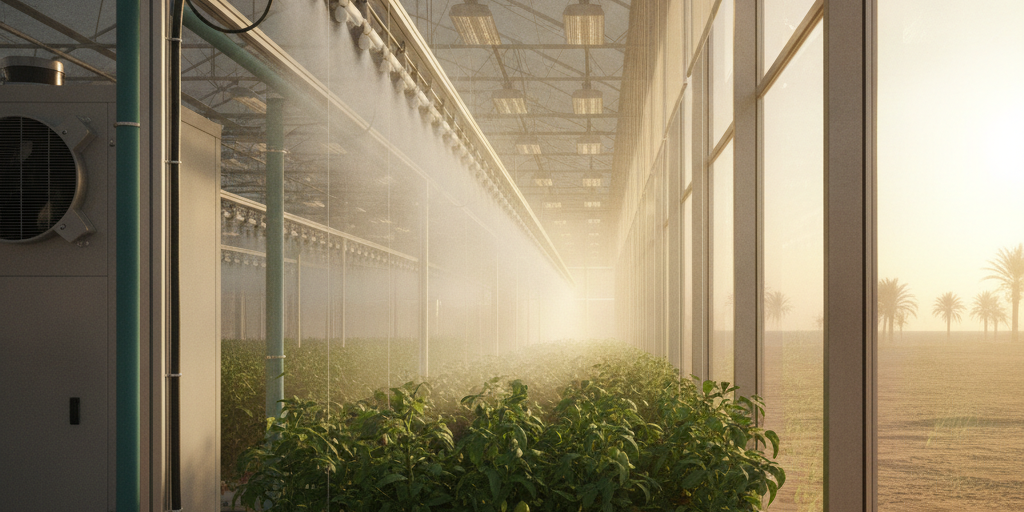
The Energy Conundrum of Greenhouse Cultivation in the UAE Climate: Cooling
As the United Arab Emirates (UAE) emerges as a hub for modern agricultural technologies, the region’s desert climate presents significant engineering challenges. Outdoor temperatures consistently exceeding 45-50°C throughout the year make greenhouse cultivation almost entirely dependent on effective cooling systems. This situation positions greenhouse cooling energy consumption UAE as one of the most critical operational cost items for investors. A successful greenhouse project is achievable not only through efficient production but also by intelligently managing this energy consumption.
At Green Climate, for our projects in challenging climates like the UAE, we prioritize long-term energy and water consumption of cooling systems over their initial investment cost. In this article, we will examine the energy profiles of different cooling technologies, the factors influencing consumption, and strategies to enhance energy efficiency for sustainable production, all from an engineering perspective.
Why is Greenhouse Cooling So Energy-Intensive in the UAE?
The high energy cost of cooling a greenhouse in the UAE stems from a unique combination of physical and environmental conditions. Understanding these factors is the first step toward selecting the right technology. There is an immense thermal load that must be overcome to maintain the ideal temperature inside the greenhouse (typically 22-26°C).
The primary reasons behind this high energy demand are:
- High Solar Radiation: The intense and continuous sunlight in the region passes through the greenhouse covering, causing a significant heat buildup (greenhouse effect) inside. This is the primary heat gain that needs to be mitigated.
- Extreme Ambient Temperature: Outdoor air temperatures far exceeding the ideal temperature for plants mean a constant influx of heat through both convection and ventilation. This necessitates almost continuous operation of cooling systems.
- High Delta T (Temperature Difference): The targeted temperature difference (Delta T) between the inside and outside of the greenhouse is considerably large. Creating and maintaining this difference thermodynamically translates directly to energy consumption.
- Humidity Management Challenges: Especially in coastal areas (such as Dubai, Abu Dhabi), the high humidity of the outdoor air reduces the efficiency of evaporative cooling systems and may necessitate additional dehumidification, which incurs an extra energy cost.
Comparison of Greenhouse Cooling Systems’ Energy Consumption for the UAE
Each cooling technology has its unique energy profile, water consumption, and investment cost. In a market like the UAE, there isn’t a single “best” solution; the correct choice depends on many factors such as the project’s location, scale, budget, and target crop. Let’s now examine the most common greenhouse cooling systems and their energy footprints.
1. Evaporative Cooling: Fan-Pad Systems
Fan-Pad systems operate on the principle of drawing air through wetted cellulose pads along one wall using powerful exhaust fans. As water evaporates, it draws heat from the air, and cooler air enters the greenhouse. The two main components determining the energy consumption of this system are the large exhaust fans that move massive volumes of air and the water circulation pumps that keep the pads continuously wet.
From an energy efficiency perspective, Fan-Pad systems can be effective, particularly in the interior and drier regions of the UAE. However, their efficiency decreases during the humid summer months along the coastline due to reduced evaporation capacity, requiring fans to operate longer to achieve the desired temperature. This directly impacts UAE greenhouse cooling costs.
2. High-Pressure Fogging Systems
These systems atomize water into micron-sized droplets by passing it through special nozzles at very high pressure (typically 70-100 bar). These tiny water droplets rapidly evaporate (flash evaporation) while suspended in the air, drawing heat from the environment. The main source of energy consumption is the high-pressure pump unit that brings the water to this pressure. Although additional fans may be required for circulation, their energy consumption is generally lower than that of exhaust fans in Fan-Pad systems.
High-pressure fogging systems provide more homogeneous cooling and humidification compared to Fan-Pad systems. Water efficiency is higher. Energy consumption, especially in large greenhouses, can be more efficient per square meter than Fan-Pad systems because less air volume needs to be moved. High-pressure greenhouse fogging systems, a specialty of Green Climate, offer an effective solution under UAE conditions when designed correctly.
3. Active Cooling: Chiller (Chilled Water) and HVAC Systems
These systems operate by sending water cooled in a chiller unit to air handling units (AHUs) inside the greenhouse. AHUs cool and dehumidify the air inside the greenhouse by passing it over these cold coils. This provides precise climate control, entirely independent of outdoor air conditions. However, this precision comes at a cost.
In terms of energy consumption, chiller and HVAC systems are by far the most intensive. Chiller compressors, water pumps, and AHU fans operate continuously, constituting the largest portion of the greenhouse cooling energy consumption UAE budget. These systems are typically preferred only for cultivating very high-value crops (e.g., pharmaceutical plants or specialty fruits) or in closed-system farming applications.
Key Greenhouse Design Factors Affecting Energy Consumption
Beyond the type of cooling system, the design of the greenhouse itself and the materials used profoundly impact total energy consumption. An energy-efficient greenhouse should be a structure that passively minimizes heat gain.
- Shading Systems: Automatic and multi-layered shading screens can reduce the cooling load by 30-50% by preventing solar radiation from entering the greenhouse. This means cooling systems operate less.
- Greenhouse Covering Material: IR (infrared) additive or specially coated polyethylene films, polycarbonate sheets, and diffuse glass can transmit light in beneficial spectra for plants while reflecting heat-generating radiation. This is a critical choice for energy efficiency.
- Greenhouse Height and Volume: A taller greenhouse creates a larger buffer zone for hot air to accumulate above plant level. This provides a more stable microclimate around the plants and reduces the need for the cooling system to cope with sudden peaks.
- Natural Ventilation: Correct positioning and automation of roof and side ventilation windows can significantly save energy, especially during transitional seasons and at night, by reducing the need for mechanical cooling.
- Automation and Control: Smart climate control computers process real-time data from sensors (temperature, humidity, radiation) to operate cooling systems only when and at the capacity needed. This prevents unnecessary energy expenditure.
Strategies to Reduce Greenhouse Cooling Energy Costs in the UAE
High energy consumption is a reality, but managing and reducing these costs is possible. A holistic approach is necessary for sustainable operation. This approach should include a combination of the right technology, intelligent design, and renewable energy sources.
Integrated and Hybrid Cooling Approaches
Instead of relying on a single cooling system, hybrid models that combine different systems are becoming increasingly popular. For example, meeting the base cooling load with more efficient high-pressure fogging and supplementing this system with a small-capacity chiller during the hottest hours or high humidity conditions can optimize total energy consumption.
When managed by a climate control computer, these integrated systems automatically activate the most cost-effective cooling method at any given moment. This provides both operational flexibility and cost advantages.
Renewable Energy Integration: Solar Panels (PV)
One of the UAE’s greatest advantages is abundant and continuous sunlight. This means that solar energy production peaks precisely when cooling demand is highest. Photovoltaic (PV) panels installed on the greenhouse roof or nearby can meet a significant portion of the electricity consumed by cooling systems.
Important: PV system investment should be planned after carefully analyzing the greenhouse’s total energy needs and grid connection conditions. Options for storing excess energy generated during the day or selling it to the grid directly impact the project’s financial feasibility.
Managing the Water and Energy Nexus
In the UAE, water is a resource as valuable as energy. Water treatment (especially reverse osmosis) and distribution also incur significant energy costs. Therefore, choosing water-efficient cooling and irrigation systems indirectly saves energy.
For example, modern hydroponic greenhouse systems use significantly less water than traditional irrigation. Similarly, high-pressure fogging systems can achieve the same cooling effect by evaporating less water compared to Fan-Pads. This reduces both the water bill and the energy expended for water supply.
Designing an Energy-Efficient Future with Green Climate
In conclusion, greenhouse cooling energy consumption UAE is a variable that holds the key to success in the market. High energy costs can be managed with the right engineering approach and transformed into a profitable agricultural investment. This is achievable not merely by selecting the most expensive equipment, but by designing the entire system holistically.
At Green Climate, we begin every project with a customized energy and climate modeling. By optimizing all elements, from greenhouse structure and shading strategies to cooling technology and renewable energy integration, we offer investors both efficient and sustainable solutions. Contact us to evaluate your project’s potential energy consumption and efficiency opportunities, and request a greenhouse cooling assessment.
Frequently Asked Questions
What is the best greenhouse cooling system for the UAE?
There is no single ‘best’ system. The choice depends on many factors such as the type of crop, greenhouse location (coastal/inland), budget, and water resources. Often, the most effective solution is a hybrid approach combining different technologies.
How much can solar panels reduce my cooling costs?
Solar panels can significantly reduce energy costs, especially during daytime hours when cooling demand is highest. The exact percentage depends on the installed panel capacity and the cooling system’s consumption, but a coverage rate of 40-70% can be targeted.
Is high-pressure fogging effective during Dubai’s humid summers?
As outdoor humidity increases, the evaporation capacity of high-pressure fogging, and thus its cooling effect (Delta T), decreases. However, it still provides some cooling and is often very effective as part of a hybrid solution combined with other systems like dehumidification or mechanical cooling.
What is the payback period for an investment in an energy-efficient cooling system?
The payback period varies greatly depending on electricity prices in the UAE, the initial investment difference, the value of the crop grown, and the amount of energy saved. Generally, a payback period of 3 to 7 years can be expected for such investments.
For your greenhouse climate control project, get a free survey and quote from Green Climate’s expert team: Contact us.